Korean Pharmacy and Drugstore Products Worth Buying, and How the Tax Refund Works
What to buy at Korean pharmacies and Olive Young drugstores, how the 15,000-won tax refund works with your passport, and what to leave off your trip home.
Table of contents
Shopping in Korea for health and beauty products usually means two different stops: the pharmacy (약국), where a licensed pharmacist sells medicines like Centella creams and pain patches, and the health-and-beauty drugstore, led by Olive Young, where you pick up sunscreen, sheet masks, and cosmetics. As of July 2026, Korea's tax-refund rules for tourists set the minimum qualifying purchase at 15,000 won in a single transaction, and shops such as Olive Young can knock the refund off at the register when you show a physical passport. This guide is for short-term visitors and new residents buying over-the-counter items for personal use. It does not cover prescription drugs, and it is general information rather than medical advice.
Pharmacy or drugstore? Knowing which stop you need
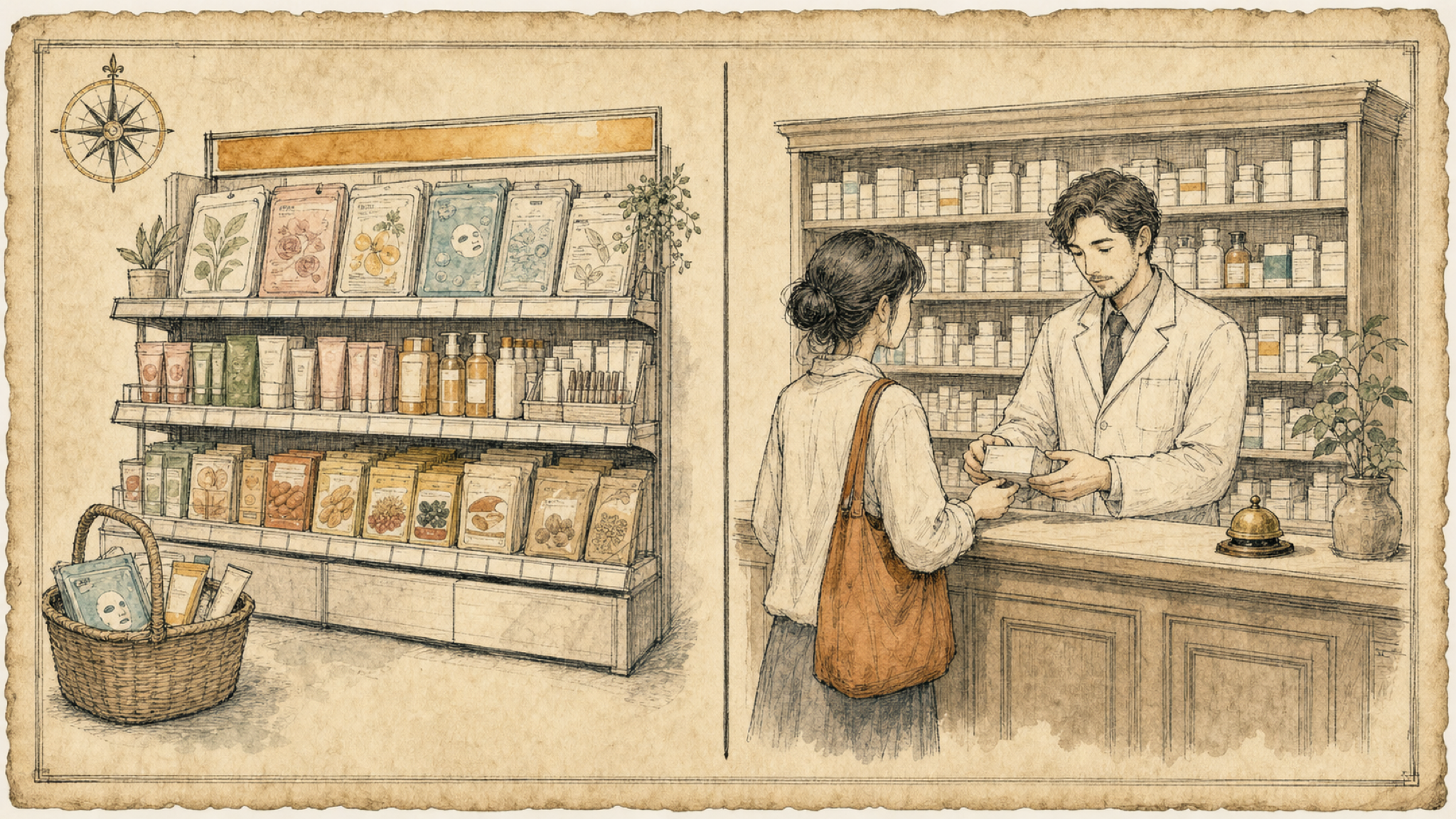
Korea splits these purchases across two kinds of store, and mixing them up costs you time. The pharmacy is the only place licensed to sell most medicines, with a pharmacist (약사) working behind the counter who can suggest something for your symptoms. The drugstore, meanwhile, is a beauty-and-wellness shop that does not sell prescription drugs at all.
Olive Young is the name you'll see most. It is a health-and-beauty chain owned by CJ Group, and it opened its first store in the Sinsa-dong area of Seoul in 1999. Industry data compiled by Statista put the chain at more than 1,300 stores across South Korea as of 2024, so you are rarely far from one in a city. Neighborhood pharmacies keep shorter hours: guides for foreign residents report that a typical pharmacy opens around 10 a.m., closes by about 7 p.m., and often shuts on Sundays and public holidays.
| Store | What you buy there | Good to know |
|---|---|---|
| Pharmacy (약국) | OTC and prescription medicine, pain patches, wound creams | Pharmacist on site; often closed Sundays |
| Drugstore / H&B (Olive Young) | Skincare, sunscreen, makeup, sheet masks | No prescription drugs; instant tax refund with passport |
What to buy at the drugstore
At a health-and-beauty store like Olive Young, the strongest categories are skincare and sun care. A few things travelers reliably stock up on:
- Facial sunscreen. Korean sunscreens tend to have light, non-greasy textures, and retail listings put most of them in the ₩10,000–20,000 range.
- Hydrocolloid pimple patches. These are small stickers that cover a blemish overnight. The COSRX Acne Pimple Master Patch is a widely sold example and packs flat for travel.
- Sheet masks. Sold individually for a few thousand won each, so you can grab a stack rather than a boxed set.
- Cushion foundations, low-pH cleansers, and toner pads. Everyday basics that are cheaper and more varied here than in most home markets.
None of these are medicines, which is exactly why the drugstore can sell them and process your refund at checkout.
What to buy at the pharmacy (약국)
The pharmacy is where the genuinely useful travel medicine lives. A short list worth knowing:
- Madecassol. A cream built around Centella asiatica extract, used on minor cuts and skin irritation. Retail price guides list a 5 g tube at roughly ₩4,500–5,000.
- Medicated pain patches. Ketoprofen patches such as Ketotop are a fixture in Korean homes for sore backs and stiff necks.
- Children's fever syrup in stick packs. Products like Champ come in single-dose sachets, which are easy to pack and dose on the road.
- Digestive aids and cold medicine. Describe your symptoms and the pharmacist will hand you the right box.
Because these are real drugs and not cosmetics, tell the pharmacist about any conditions, pregnancy, or medicines you already take, and keep the leaflet that comes in the box.
How does the tax refund work when you shop?
You qualify for a refund when you spend at least 15,000 won in one transaction at a participating store, and you have to show a physical passport. At Olive Young and many other shops, the amount is simply deducted at the register (an "immediate" refund) rather than claimed later.
According to Korea.net, the Republic of Korea's official government site, the government doubled the immediate tax-refund ceiling in 2024, raising the single-purchase limit to 1,000,000 won and the combined-stay limit to 5,000,000 won, up from the previous 500,000 and 2,500,000. Above those limits, or if the shop cannot process it in store, you keep the refund slip and claim it at the airport refund counter before you fly out. One expectation to set: tourist tax-refund guidance notes that the cash you actually get back is usually about 4–7% of the price, not the full 10% VAT, because the refund operator takes a fee. Eligibility runs to foreign visitors whose total stay is under six months; you can confirm the current rules through the Korea Tourism Organization. The same tax-free logic shows up across the region, and it is worth comparing with how Japanese drugstores handle tax-free shopping if your trip covers both countries.
Where can you buy medicine after the pharmacy closes?
When pharmacies are shut at night or on a holiday, 24-hour convenience stores stock a short list of approved medicines. Under Korea's Safety OTC Medicine system, which the Ministry of Health and Welfare launched on November 15, 2012, chains like CU, GS25, and 7-Eleven may sell 13 essential items outside pharmacy hours, including acetaminophen (Tylenol), some cold medicines, digestive aids, and muscle-pain patches.
If you need something that is not on that convenience-store list late at night, call the 1339 health information line, which can point you to the nearest late-night pharmacy (심야약국). Larger neighborhoods and hospital districts are the most likely to have one open.
What to leave off your trip home
Before you fill a basket, remember that a medicine sold freely in Korea can be restricted where you live. Customs rules vary by country: some limit or ban cold and allergy medicines that contain active ingredients such as pseudoephedrine or codeine, and others cap how much of any medicine you can bring in for personal use.
The safe habits are simple. Keep products in their original packaging with the leaflet, carry only reasonable personal quantities rather than a suitcase of one product, and check the customs rules for your home country and anywhere you transit. We cover the same trap for another country in our guide to Thai pharmacy products and what not to take home. For skincare, sunscreen, and sheet masks you will almost never have a problem, so most of this caution applies to the actual medicines from the pharmacy, not the beauty haul from Olive Young.