Butsukari Otoko: What Japan's Shoulder-Bumping Is and How to Stay Safe
Butsukari otoko are people who deliberately bump strangers in Japan's crowded stations — what it is, who it targets, and how to stay safe and report it.
Table of contents
"Butsukari otoko" — Japanese for "bumping man" — is the nickname for a person who deliberately shoulder-checks or slams into strangers in crowded public places, most often busy train stations. If you are visiting or moving to Japan and this worries you, the short answer is that it is a real, reported behavior but not something most travelers ever run into, and the response is the same as for any aggressive stranger: keep yourself safe, step out of the crowd, and report it to station staff or police on 110. Japanese and international news outlets have documented the pattern since a widely shared video filmed at Tokyo's Shinjuku Station in 2018. As of July 2026, this guide explains what the phenomenon is, who tends to be targeted, and how ordinary travelers and residents can handle Japan's crowded stations. It is general safety information for the public, not legal advice, and it does not cover how to pursue a court case.
What does "butsukari otoko" actually mean?
"Butsukari otoko" means "bumping man" in Japanese. It describes a person who walks into strangers on purpose — a shoulder check, an elbow, or a full body slam — usually in a packed station or on a crowded sidewalk. The key point is that the contact is deliberate, not the ordinary jostling everyone does during a busy commute.
That distinction matters, because Japanese stations get genuinely tight during weekday commuter peaks, and a certain amount of shoulder-brushing is normal. A butsukari otoko exploits exactly that cover. Outlets including Japan Today and The Japan Times trace the current wave of attention to a blurred video filmed at Shinjuku Station that spread across Twitter and YouTube in 2018, showing a man walking into one woman after another. After that video went viral, coverage of the phenomenon reported that railway operator JR East labeled deliberate bumping as disruptive behavior and increased monitoring by security guards and station staff.
Who gets targeted, and why does it happen?
The person doing it is usually picking someone who looks unlikely to push back. Reporting on these cases describes a fairly consistent pattern: the people involved are usually men, often in their forties or older, and smaller women are targeted more often than anyone else. The numbers give a sense of scale: in a 2024 survey of nearly 22,000 people by the IT consultancy MediaSeek, reported in international coverage, 14% said they had been the victim of deliberate bumping and 6% said they had witnessed it.
The motives that come up are less tidy. Criminologists quoted in Japanese outlets such as Toyo Keizai and Yahoo News Japan point to everyday stress and resentment being taken out on an easy target; a smaller share of cases shade into groping, where the "accident" is a cover for unwanted touching. You do not need to work out the motive in the moment. What matters is recognizing that a hard, aimed hit in a crowd is not always an accident.
How can you lower your risk in a crowded station?
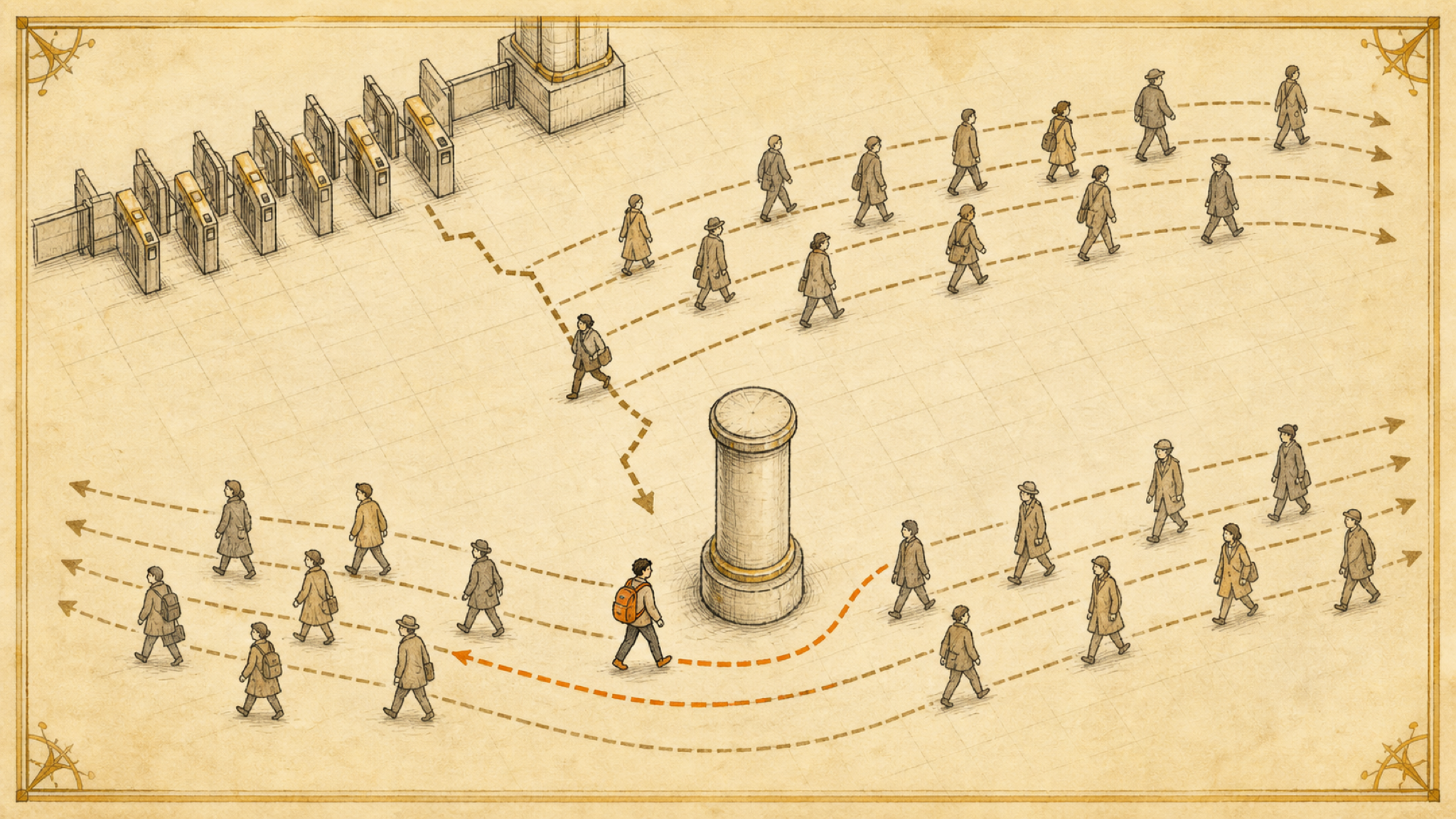
Keep your attention up and give yourself room to move — that one habit does most of the work. The same situational-awareness routine that helps you stay ahead of pickpockets in a busy crowd applies almost exactly here.
A few specific things that help in Japanese stations:
- Put your phone away while walking. Head-down texting makes you the easiest target on the concourse and slows your reaction.
- Walk on the side of the flow rather than down the middle, and follow the local pattern — many stations mark whether to keep left or right on stairs and platforms.
- Carry a bag or daypack in front of you during rush hour. It gives you a buffer and keeps your belongings in view.
- Hold the handrail on stairs and escalators, so a sudden shove is less likely to knock you off balance.
- When you can, skip the tightest crush of the morning and evening commuter peaks and wait for the next, emptier train.
None of this is about fear. It is the same low-effort caution you would use in any dense transit hub anywhere in the world.
What to do if someone bumps you on purpose
Get steady and safe first, then report it. If someone slams into you and you are hurt or shaken, move out of the flow of people, check yourself for injuries, and, if you feel able, say something loud enough for others to notice. Bystanders and station staff are far more useful than a private confrontation.
Every Japanese station has staff at the ticket gates or a station office; flag them down and they can call security or the police. The National Police Agency of Japan says the nationwide number to reach police in an emergency is 110. You can read more on the agency's English site at npa.go.jp/english. If you were hurt, keep any medical records and note the time, station, and platform — that detail helps if you decide to file a report.
One thing worth saying plainly: hitting back is risky, both physically and legally. Retaliation can turn you from the person reporting an assault into a second party the police have to sort out.
How Japanese law treats deliberate bumping
Deliberately bumping into someone can be a crime in Japan. Under Japan's Penal Code, walking into a person on purpose can be treated as assault (暴行罪, Article 208) even if it leaves no injury; if it causes injury, it can rise to the more serious offense of causing bodily harm (傷害罪, Article 204). Japan's Penal Code sets the penalty for assault under Article 208 at up to two years' imprisonment or a fine of up to ¥300,000, with heavier penalties where injury results.
These are not just words on paper. Japanese media have reported arrests over the years — for example, coverage described a man in his late forties injuring three women at Nijūbashimae Station in September 2019, and another man harming six women at Kamata Station in July 2020. In 2025, several outlets reported the repeated arrests of a university associate professor in Fukuoka accused of bumping and striking pedestrians. Cases like these are why station staff and police take a report seriously rather than waving it off as commuter chaos.
For the vast majority of visitors and residents, a deliberate bump is something you will read about far more often than you will experience. Knowing the word, the pattern, and the simple response — stay aware, protect yourself, and report it — is enough to keep Japan's crowded but otherwise remarkably orderly stations feeling exactly that way.