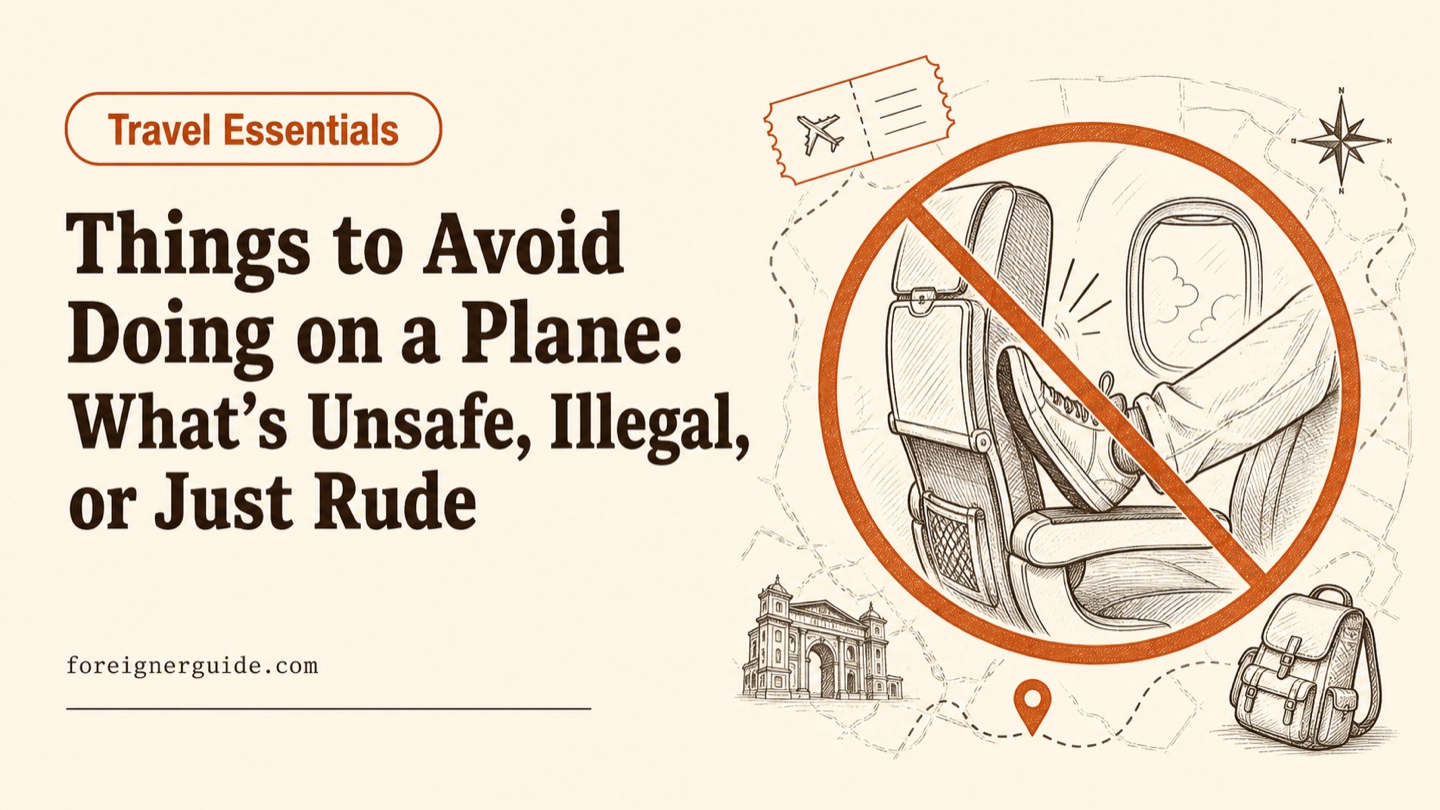
Things to Avoid Doing on a Plane: What's Unsafe, Illegal, or Just Rude
US rules ban drinking your own alcohol and defying crew, the CDC flags blood-clot risk past four hours, and small courtesies keep a cramped cabin civil.
Table of contents
The behaviors worth avoiding on a plane fall into three groups: the ones that break federal rules, the ones that quietly hurt your body, and the ones that just make you the passenger everyone remembers for the wrong reasons. Ignoring a crew member's instruction and drinking your own alcohol are actual violations of US aviation rules; sitting frozen for hours raises a health risk the CDC tracks; and a handful of small courtesies keep a cramped cabin bearable. This guide covers commercial flights and leans on US federal rules from the FAA for the legal parts. Carriers in other countries follow similar logic, and the etiquette applies anywhere. If you are still sorting out fares and routes, our guide to flights, lodging, and daily costs covers that side. Here we start the moment you step on board.
Don't treat a crew member's instruction as a suggestion
The fastest way to turn an ordinary flight into a legal problem is to argue with or ignore the cabin crew. Under US law, interfering with a flight crew is a federal offense, not an airline house rule.
The FAA says it can propose civil penalties of up to $43,658 per violation for unruly behavior, and a single incident can carry several violations. When conduct crosses into assault or intimidation, the case moves to criminal court. Federal law under 49 U.S.C. § 46504 allows prison terms of up to 20 years and fines up to $250,000, with heavier penalties if a weapon is involved. The FAA says it has referred more than 270 of its most serious cases to the FBI since late 2021. You can read the agency's case summaries and current policy on its unruly passengers page.
In practice this is simple. Fasten your seatbelt when asked, stow your bag when asked, and take any disagreement to customer service on the ground rather than to the aisle at 35,000 feet. An instruction during boarding, taxi, or turbulence is an order you are legally expected to follow.
Can you drink your own alcohol on a plane?
No, not on a US commercial flight. The rule is 14 CFR 121.575, which states that no person may drink any alcoholic beverage aboard an aircraft unless the airline operating the flight served it to them. The duty-free bottle in your bag stays sealed until you land.
The same rule bars crew from serving anyone who appears intoxicated and from letting an obviously drunk passenger board. The FAA has repeatedly fined passengers for alcohol-related unruly behavior, so pacing yourself is both a courtesy and a way to stay out of trouble. You can read the regulation in full through the Legal Information Institute's copy of 14 CFR 121.575.
Is sitting still on a long flight really a health risk?
It can be, and the CDC treats it seriously. According to the CDC, sitting still in a confined space on any trip longer than four hours raises the risk of deep vein thrombosis, a blood clot that usually forms in a deep vein of the leg, and the longer you stay immobile, the higher that risk climbs.
The CDC's suggestions take little effort. Get up and walk the aisle every couple of hours when the seatbelt sign is off, flex your calves and ankles while seated, and pick an aisle seat when you can, since the CDC notes aisle seats show a protective effect simply because people there move more. It also points to graduated compression stockings for travelers at higher risk. Drinking water helps too, if only because it keeps you from staying sealed in one position for the whole flight. This is general information, not medical advice; if you have clotting risk factors, ask your doctor before a long-haul trip. The CDC's full travel guidance is on its blood clots and travel page.
Cabin etiquette worth getting right
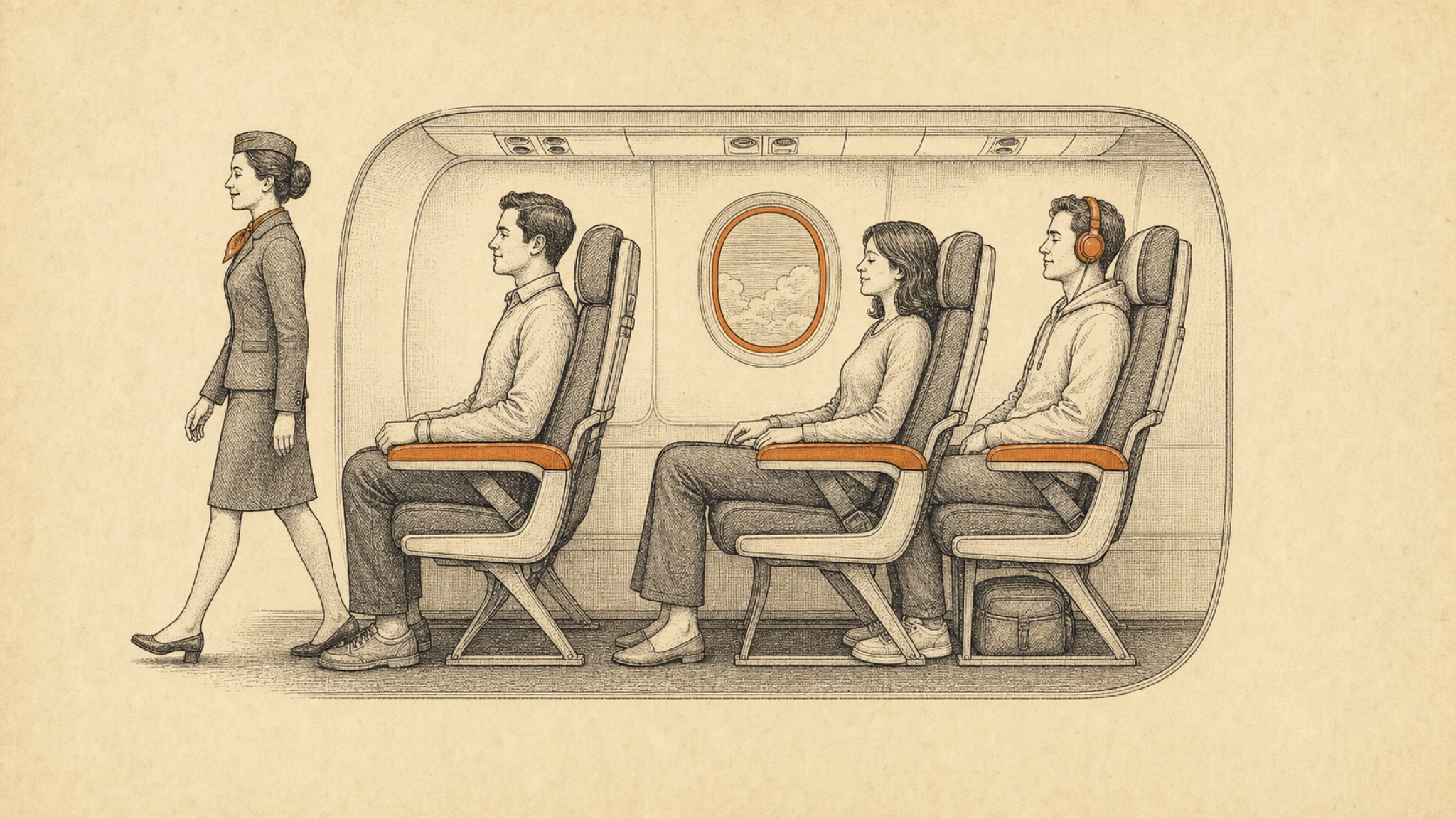
None of these are illegal. They are the difference between a tolerable flight and a miserable one for the people around you.
- Reclining your seat suddenly, especially during meal service. Glance back first, then ease it down.
- Claiming both armrests. The unwritten rule gives the middle seat both armrests, since the aisle and window seats already have an edge to lean on.
- Taking off your shoes and socks, or propping bare feet on a bulkhead or the seat in front of you.
- Playing music, videos, or calls out loud. Headphones are the baseline, and the phone goes away for takeoff and landing when asked.
- Standing to open the overhead bin the instant the plane lands. Wait until the aisle ahead of you actually starts to move.
- Blocking the boarding lane before your zone is called, then holding up the aisle while you slowly load your bag. Store it wheels-first and step into a row to let others pass.
- Strong perfume, pungent hot food, and letting kids kick the seat in front. Small things fill a sealed cabin fast.
Don't waste worry on things that aren't real risks
Some of the most common flying anxieties don't match the facts, and stressing over them only makes the trip worse.
Recycled cabin air is the classic example. The FAA says most US commercial airplanes use high-efficiency particulate air (HEPA) filters that remove 99.97% of airborne particles, and the cabin runs on a continuous blend of fresh outside air and filtered recirculated air. The bigger hygiene factor is what you touch, namely tray tables, seatbelt buckles, and lavatory handles, so a small bottle of hand sanitizer does more for you than holding your breath. And keep your phone, passport, and wallet with you rather than in the seat-back pocket, where they are the most-forgotten items on any flight. The same steady, low-drama habits that help you keep valuables safe on the ground serve you just as well in the air: awareness, not panic.