Useful Japanese Phrases to Know Before Your Japan Trip
A practical starter set of Japanese phrases for a Japan trip: greetings, sumimasen, asking prices and directions, plus JNTO's list and free apps like VoiceTra.
Table of contents
- Start here: the ten phrases that carry a trip
- Why sumimasen is the first word to learn
- How do you ask where something is or what it costs?
- Ordering food and paying the bill
- Do you actually need to speak Japanese to get around?
- Small habits that make your phrases land
- What to run through before you land
You do not need to be fluent to travel comfortably in Japan. A dozen or so spoken phrases — a greeting, a polite way to get attention, a thank-you, and two or three simple questions — cover most of what a visitor meets at train stations, shops, and restaurants. The Japan National Tourism Organization (JNTO), the country's official tourism body, publishes a short list of everyday phrases for travelers, and its own guidance is that a few words smooth your way even when the rest of your sentence stays in English. This guide is for short-term visitors who want a practical starter set for a trip, so it sticks to spoken phrases you can use on day one and leaves writing systems and formal grammar for another visit.
Start here: the ten phrases that carry a trip
These ten handle greetings, asking for help, and the two questions travelers reach for most. Read the romanized spelling roughly as it looks in English and people will follow you.
| Japanese | Phrase (romaji) | Meaning | When to use |
|---|---|---|---|
| こんにちは | Konnichiwa | Hello / good afternoon | General daytime greeting |
| すみません | Sumimasen | Excuse me / sorry / thanks | Getting attention or apologizing |
| ありがとうございます | Arigatou gozaimasu | Thank you (polite) | After any help or service |
| お願いします | Onegaishimasu | Please | Making a request or ordering |
| はい / いいえ | Hai / Iie | Yes / No | Basic answers |
| 分かりません | Wakarimasen | I do not understand | When a conversation loses you |
| 英語が話せますか | Eigo ga hanasemasu ka | Do you speak English? | Asking for help in English |
| どこですか | Doko desu ka | Where is it? | Finding a place (add a place name) |
| いくらですか | Ikura desu ka | How much is it? | Checking a price |
| 大丈夫です | Daijoubu desu | I am fine / no thank you | Declining politely |
Several of these appear on JNTO's own list of travel phrases — sumimasen, arigatou, and ikura desu ka among them — along with ohayou gozaimasu (good morning), a useful eleventh to add for early starts. Learn only this set and you still cover a large share of an ordinary day.
Why sumimasen is the first word to learn
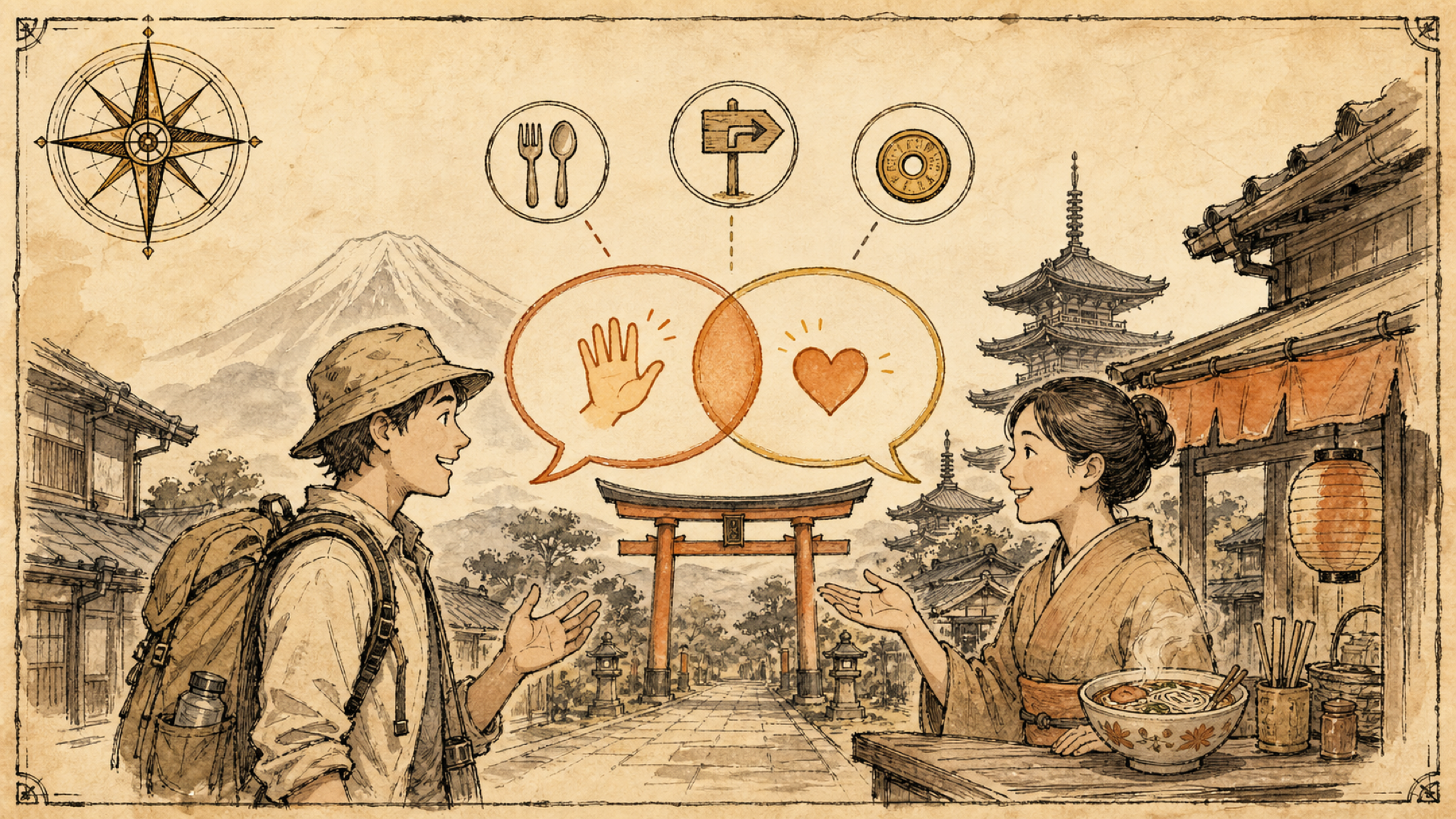
If you memorize one word, make it sumimasen. JNTO notes that it stretches across "excuse me," "sorry," and even a light "thank you," depending on the moment. You use it to catch a server's eye, to slip past someone on a packed platform, to apologize for a small bump, and to acknowledge a kindness. One word, four everyday jobs. Say it a little softer when you are apologizing and a little brighter when you are flagging someone down, and the meaning comes through.
How do you ask where something is or what it costs?
Attach the place or item to a fixed ending. Use "... wa doko desu ka?" for "where is ...?" and "... wa ikura desu ka?" for "how much is ...?" So "Toire wa doko desu ka?" means "Where is the toilet?" and "Eki wa doko desu ka?" means "Where is the station?" To check a price, point and say "Kore wa ikura desu ka?" — "How much is this?"
The one snag is that the answer comes back in Japanese, often faster than you can parse. A simple workaround: ask the person to write the number down, or watch the register display, which shows the total in figures. When you are price-checking cosmetics or medicine, this question pairs neatly with understanding how tax-free counters and drugstore prices work, so you know what you are actually paying before you commit.
Ordering food and paying the bill
Meals come with a couple of small spoken rituals. Many Japanese speakers say itadakimasu before they start eating, roughly "I gratefully receive this meal," and gochisousama deshita afterward, a thank-you for the food. To order, you can point and say "Kore o kudasai" (this one, please) or add "... o onegaishimasu" to what you want. Ask for the check with "O-kaikei onegaishimasu." At a konbini (a convenience store such as 7-Eleven, FamilyMart, or Lawson), staff often ask whether you want a bag; "Fukuro wa irimasen" means "I do not need a bag," and "Daijoubu desu" works as a polite "no thanks."
Do you actually need to speak Japanese to get around?
No. Major-city stations, airports, and many restaurants use bilingual Japanese and English signage, and free apps close the gaps. VoiceTra, a free speech-translation app from Japan's National Institute of Information and Communications Technology (NICT), is built specifically for travel conversations; per NICT's VoiceTra page, it covers 33 languages and runs on iOS and Android, though it needs an internet connection to translate. Google's Translate app is also widely used for its camera mode, which reads printed menus and signs. For getting around, a phrase or two works best alongside offline maps and saved place lists in a navigation app, so you are not depending on a signal underground. Public broadcaster NHK also runs a free "Easy Travel Japanese" video series through NHK WORLD-JAPAN if you want to hear the phrases before you fly.
Small habits that make your phrases land
Tone and gesture carry as much as vocabulary here. A slight nod of the head with your thank-you, a lower voice on trains, and the polite endings gozaimasu and onegaishimasu all read as respect. JNTO's etiquette guidance stresses that courtesy matters more than perfect grammar, so a clumsy phrase offered warmly beats a silent transaction. Keep requests short, lead with sumimasen to soften them, and you will rarely put a foot wrong.
What to run through before you land
If you have a flight to fill, drill in this order: sumimasen, arigatou gozaimasu, and onegaishimasu first; then the two questions built on doko desu ka and ikura desu ka; and finally eigo ga hanasemasu ka ("Do you speak English?") as your escape hatch when a conversation runs ahead of you. Download a translation app before you leave so it is set up and signed in, and keep the phrase list above in your notes. That short set, delivered with a friendly tone, is enough to get you fed, pointed the right way, and through checkout without stress.