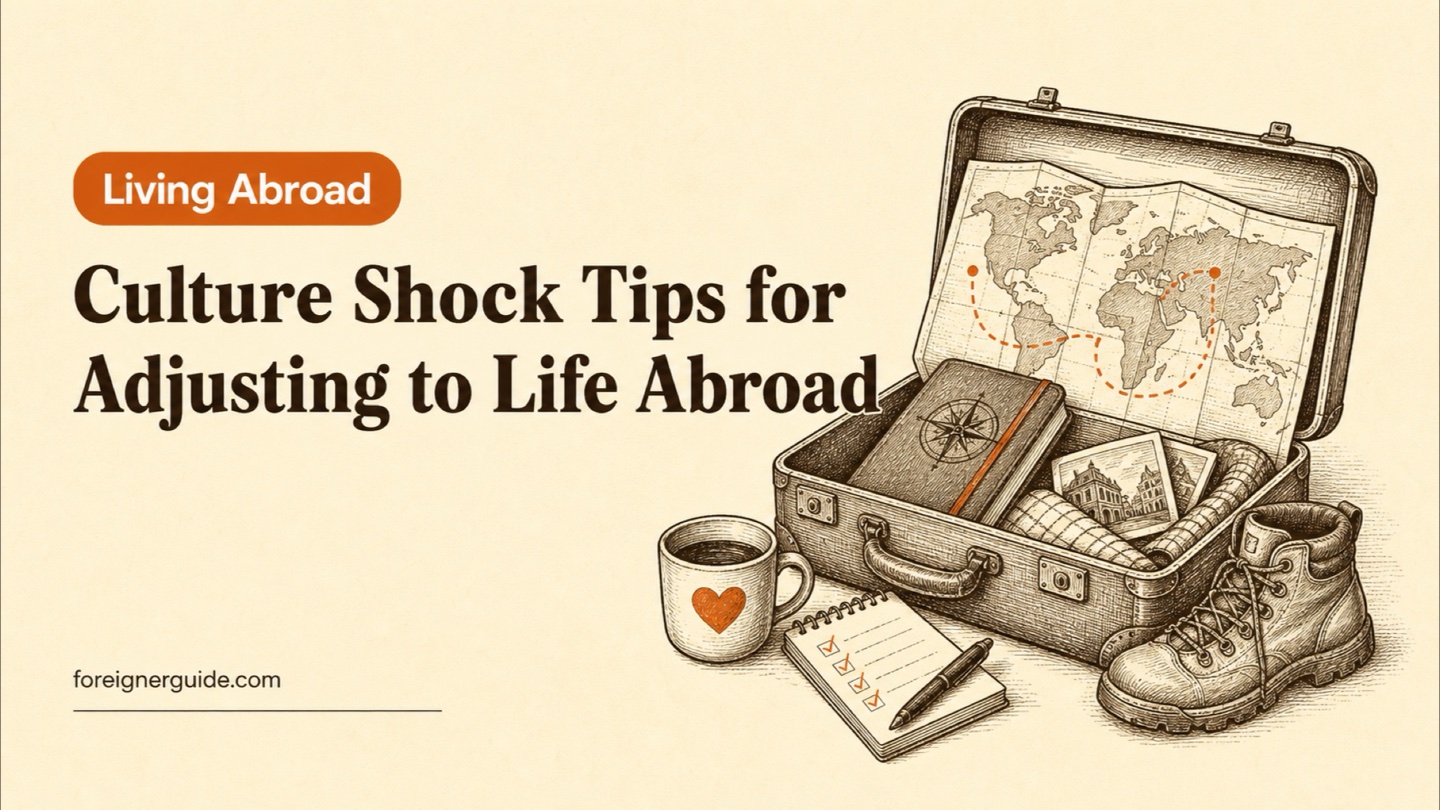
Culture Shock Tips for Adjusting to Life Abroad
Culture shock moves through predictable stages first named by Kalervo Oberg in 1960. Practical tips to settle in abroad — and to survive coming home again.
Table of contents
Moving to a new country tests more than your packing skills. Culture shock is the stress and disorientation you feel when the everyday cues you grew up with — greetings, food, work habits, personal space — suddenly stop working the way they used to. The reassuring part is that it follows a fairly predictable pattern, and it eases with time rather than lasting forever. The anthropologist Kalervo Oberg named the experience in 1960 and described it as the anxiety that comes from losing the familiar signs and symbols of daily social life. This guide stays practical rather than clinical: how to spot the stages, what to do day to day, and how to handle the strange letdown of going home. It is general information for travelers, expats, students, and remote workers settling into life abroad, not medical, legal, or financial advice.
What culture shock actually is
Culture shock is not a sign that you picked the wrong country or that you are failing at expat life. It is a normal reaction to losing your bearings. Writing in 1960, Kalervo Oberg compared it to a mild illness with real symptoms: irritability, homesickness, fatigue, and the nagging feeling that nothing quite makes sense. On their own, the frictions are small. You misread a menu, you stand too close in a queue, a simple errand takes three attempts. Stacked together, day after day, they wear you down, because your brain is doing constant translation work that used to happen on autopilot.
What are the four stages of culture shock?
Most people move through four rough stages: honeymoon, frustration, adjustment, and adaptation. The model goes back to Oberg's 1960 framework, and the U.S. State Department's guidance for exchange participants describes a similar arc of honeymoon, rejection, and recovery. These stages are not a straight line. You can slide back into frustration after a good week, and holidays or a hard day at work often set it off again.
| Stage | Common feelings | What tends to help |
|---|---|---|
| Honeymoon | Excitement, curiosity, everything feels fresh | Enjoy it, and start small routines you can keep later |
| Frustration | Irritation, homesickness, fatigue, criticism of the new place | Rest, vent to someone who gets it, lower your expectations for a while |
| Adjustment | Routines return, humor comes back, problems feel solvable | Build on the habits that work and deepen local ties |
| Adaptation | Comfort, balance, a sense that the place is partly yours | Keep your support network, and help the next newcomer |
How do you cope with culture shock day to day?
Small, steady habits work better than one grand fix. The U.S. State Department's advice for people adjusting to a new culture leans on the same idea: keep a journal, stay connected to others going through it, and get involved in the place rather than retreating into a familiar bubble. You can read the full list in the U.S. State Department's guidance on adjusting to a new culture. A few tactics that hold up in practice:
- Keep a few anchors from home — a morning coffee ritual, a weekly video call, a familiar playlist. Continuity gives your nervous system something steady to hold.
- Learn a handful of phrases first: greetings, "thank you," "I don't understand," the numbers one to ten, and how to order food. You do not need fluency to feel less helpless.
- Move your body. The State Department specifically suggests team sports or athletic activity, which builds routine and puts you around locals without the pressure of small talk.
- Find a local guide — a mentor, a long-term resident, or a colleague who will explain the unwritten rules and let you complain now and then.
- Keep a journal. Writing down what confused or delighted you turns a rough day into a story, and it lets you see your own progress a month later.
- Go easy on yourself. Tiredness and a short temper are symptoms, not character flaws. Rest is a strategy, not a reward.
Reverse culture shock: why coming home is hard
Here is the part few people warn you about: going home can be harder than leaving. Reverse culture shock is the letdown and disorientation you feel when you return to your own country after a long stretch abroad. In 1963, researchers Gullahorn and Gullahorn extended the earlier model into what is often called the W-curve — the familiar dip you feel settling in abroad, followed by a second dip when you land back home and find that friends have moved on, your stories don't land, and the place you missed now feels oddly small. The fixes are the same ones that got you through the first time. Expect the dip instead of being blindsided by it. Keep one foot in both cultures. Seek out other people who have lived abroad, because they will not get tired of the conversation.
When to reach out for help
Ordinary culture shock lifts. Feeling flat or frayed for a couple of weeks during the frustration stage is normal and expected. But if low mood, sleeplessness, or anxiety drags on for several weeks and starts getting in the way of your work, eating, or relationships, treat that as a signal rather than a phase to tough out. Many universities, employers, and relocation programs offer counseling, and telehealth now makes it possible to talk to a therapist in your own language from almost anywhere. This article is general guidance, not medical advice; a qualified professional can tell the difference between a hard adjustment and something that needs more support.