French Phrases to Use From Bonjour to the Bill
Skip fluent French - ten phrases and one habit cover most of a trip: greetings, café orders, tu vs. vous, and how to ask about English, starting with Bonjour.
Table of contents
You do not need fluent French to have a good trip. You need about ten phrases and one habit. The habit is saying Bonjour before anything else - walk into a shop, step up to a ticket window, or stop someone for directions, and the greeting comes first, ahead of your question. France's official tourism site, France.fr, run by the government agency Atout France, and ordinary local etiquette point to the same rule: greet first, ask second. This guide is for short-term travelers who want to be polite and understood, not for anyone studying grammar or moving to France. If you are still sorting out entry paperwork, that is a separate question we cover in what to confirm about travel visas before you book.
Bonjour comes before your question
In France, the greeting opens the exchange. It is not optional warmth you add when you feel like it. Skip Bonjour and go straight to "Do you have this in blue?" and you sound brusque, maybe a little rude. Say Bonjour (good day) when you enter somewhere in daylight, or Bonsoir (good evening) after dark. When you leave, Merci, au revoir (thank you, goodbye), even if you bought nothing. Add Monsieur or Madame and you sound like a local instead of a tourist. "Bonjour Madame" to the woman behind the bakery counter costs you nothing and changes the temperature of the whole exchange. The logic is plain: a request without a greeting treats the person as a machine that dispenses bread or tickets, and a greeting treats them as a person. French social life takes that difference seriously.
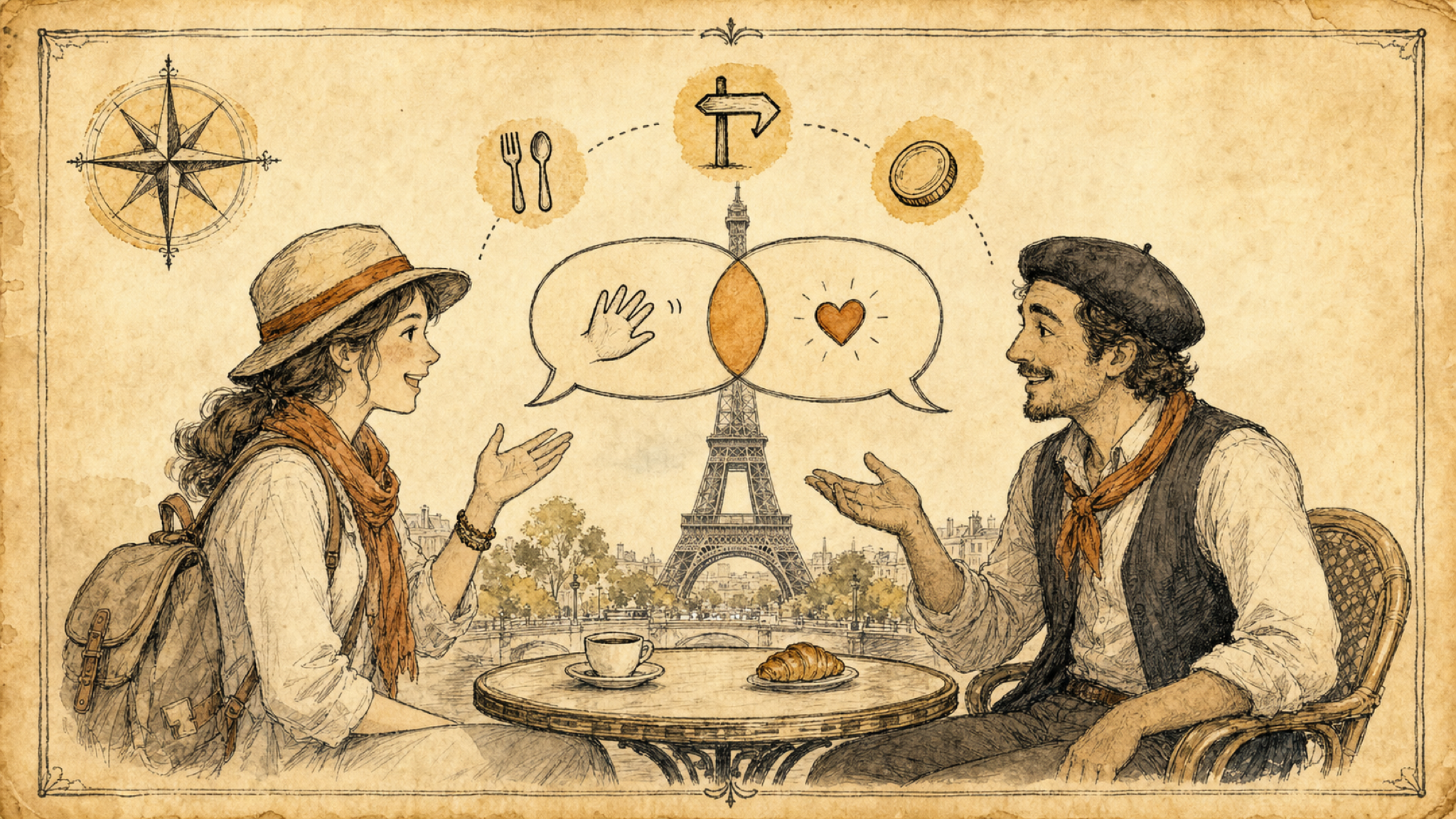
Ten phrases that carry most days
Memorize these ten and you can handle greetings, shops, and small requests without stalling. None of them need good grammar. Single words and short set phrases do most of the work.
| Phrase | Meaning | When to use |
|---|---|---|
| Bonjour | Hello / good day | Entering anywhere, daytime |
| Bonsoir | Good evening | After dark, entering or greeting |
| S'il vous plaît | Please | Any request |
| Merci | Thank you | Always |
| Au revoir | Goodbye | Leaving, even without buying |
| Excusez-moi | Excuse me | Getting attention, passing by |
| Pardon | Sorry / pardon | Bumping, squeezing past |
| Oui / Non | Yes / No | Everywhere |
| Je voudrais... | I would like... | Ordering, buying |
| L'addition, s'il vous plaît | The bill, please | Paying at a café |
Notice that S'il vous plaît (please) and Merci (thank you) attach to almost everything. In France you cannot overuse them.
Do people in France speak English?
Many do, especially younger staff in Paris and other big cities and in heavily touristed spots. But assume nothing, and do not open in English. Lead with French, then ask. Two phrases carry the moment: "Parlez-vous anglais?" (do you speak English?) and "Je ne parle pas français" (I don't speak French). Said right after Bonjour, they almost always get a friendly answer, and the other person often switches to English on the spot. Opening with "Do you speak English?" in English, before any French at all, is the move that tends to land badly. The order matters more than your accent.
Tu or vous: which "you" to pick
Use vous. French has two words for "you." Tu is informal, for friends, family, children, and pets. Vous is formal and also doubles as the plural. As a visitor talking to strangers, shop staff, waiters, and officials, vous is the respectful default, and no one takes offense if you use it with someone who would have accepted tu. The mistake that grates is the reverse - using tu with an adult stranger, which sounds overfamiliar. So when you are unsure, vous. If a French person wants to drop the formality, they will offer it: "On peut se tutoyer" means "we can use tu." Follow their lead and switch.
What do you order in a café?
A café or restaurant runs on four or five phrases. To be seated: "Une table pour deux, s'il vous plaît" (a table for two). To order: "Je voudrais..." (I would like) or "Je vais prendre..." (I'll have), then point at the menu if the words escape you. Ask for "une carafe d'eau" and you get free tap water in a jug instead of paying for a bottle. To pay: "L'addition, s'il vous plaît" (the bill, please). French menu prices already include service, printed as service compris, so tipping is a small optional gesture - rounding up or leaving a euro or two - not a 20 percent calculation. For a coffee or pastry to go, "à emporter" means takeaway and "sur place" means you will have it there.
Getting around: directions, prices, and tricky numbers
Two question words open most of getting around: "Où est...?" (where is...?) and "Combien?" (how much?). Bolt a place onto the first - "Où est la gare?" (where is the train station?) or "Où sont les toilettes?" (where are the toilets?) - and you can cross a town. For shopping, "Combien ça coûte?" asks the price at any market stall. Numbers are where visitors stumble, because French counts oddly once you pass sixty: soixante-dix is literally "sixty-ten" for 70, and quatre-vingts is "four twenties" for 80. When a spoken price slips past you, "Vous pouvez l'écrire?" (can you write it down?) saves the moment without embarrassment. If your trip runs south toward the coast, the timing and rail details in our guide to traveling the French Riviera by train pair well with this vocabulary.
Why a little French goes a long way
The reason ten phrases earn so much goodwill is that the French take their language personally, and the state does too. French is the language of the Republic under Article 2 of the French Constitution, a status written in since 1992. The language has been tended far longer than that: the Académie française, the institution that guards and codifies French, was founded in 1635, and its members maintain the official dictionary. The Académie française presented the ninth edition of that dictionary to France's president in November 2024, closing a project that had run for decades. You will never need this history to buy a train ticket. But it explains why a shopkeeper warms up when you begin in French - starting with Bonjour signals that you are meeting them on their ground, not expecting them to meet you on yours. For the background, the Académie française publishes its dictionary and usage notes openly.