Quebec City Food and History Tours: A Walk Through Old Quebec
Old Quebec, a UNESCO World Heritage site since 1985, blends 1608-era history with Quebec cooking on one walkable afternoon — what to eat, see, and how to plan.
Table of contents
A food and history tour of Quebec City means one thing in practice: walking Old Quebec, the walled historic core that the UNESCO World Heritage Centre added to its World Heritage list in 1985, while eating your way through classic Quebec cooking. Most visitors fold both into a single half-day on foot, tasting tourtière, poutine, and maple sweets between stops at centuries-old squares and the cliffs above the St. Lawrence River. You can join a guided tasting walk or plan your own route, but in a district this small the food and the history keep bumping into each other.
This guide covers the compact Old Quebec district — its Upper Town and Lower Town — rather than day trips to the wider region, and it sticks to general planning rather than specific bookings, prices, or dietary advice, which change by operator and season.
Why Old Quebec puts food and history in the same few blocks
Quebec City is one of the oldest European settlements in North America. According to Destination Québec Cité, the city's official tourism organization, Samuel de Champlain founded it in 1608, and it grew into the capital of New France. His first building, the Habitation, stood on the site of today's Place Royale in the Lower Town, the flat riverside quarter where boats once unloaded their cargo.
The city is also the only fortified city north of Mexico with its walls still standing, a point both the Ville de Québec and UNESCO make about the district. Those walls ring the Upper Town on the cliff, while the Lower Town sits below by the water. The whole historic area is walkable in an afternoon, which is why a single tour can move from a cheese counter to a 17th-century square in a few minutes. You can read the full inscription on the UNESCO World Heritage Centre listing for the Historic District of Old Québec.
What food will you actually taste?
The core of most food tours is a short list of Quebec staples: tourtière, poutine, and sugar pie, rounded out with maple products and local cheeses. Tourtière is a spiced meat pie traditionally eaten around the winter holidays. Poutine is fries topped with cheese curds and hot gravy — plain in its original form, though many kitchens now build far more elaborate versions. Sugar pie, or tarte au sucre, is a dense dessert made mostly of brown sugar or maple.
Maple runs through almost everything here, from maple butter to the boiled-sap-on-snow candy sold at sugar shacks in spring. You will also meet Quebec's cheeses, including firm and soft varieties from small dairies, and local ciders. A few things worth knowing before you graze:
- Portions add up. A tour with ten small tastings can replace a meal, so arrive hungry and pace yourself.
- Menus shift with the season — maple in early spring, apple cider and pie in autumn, hearty pies in the cold months.
- Tell your guide about allergies or restrictions in advance; small tasting stops rarely swap dishes on the spot.
The history you walk past between bites
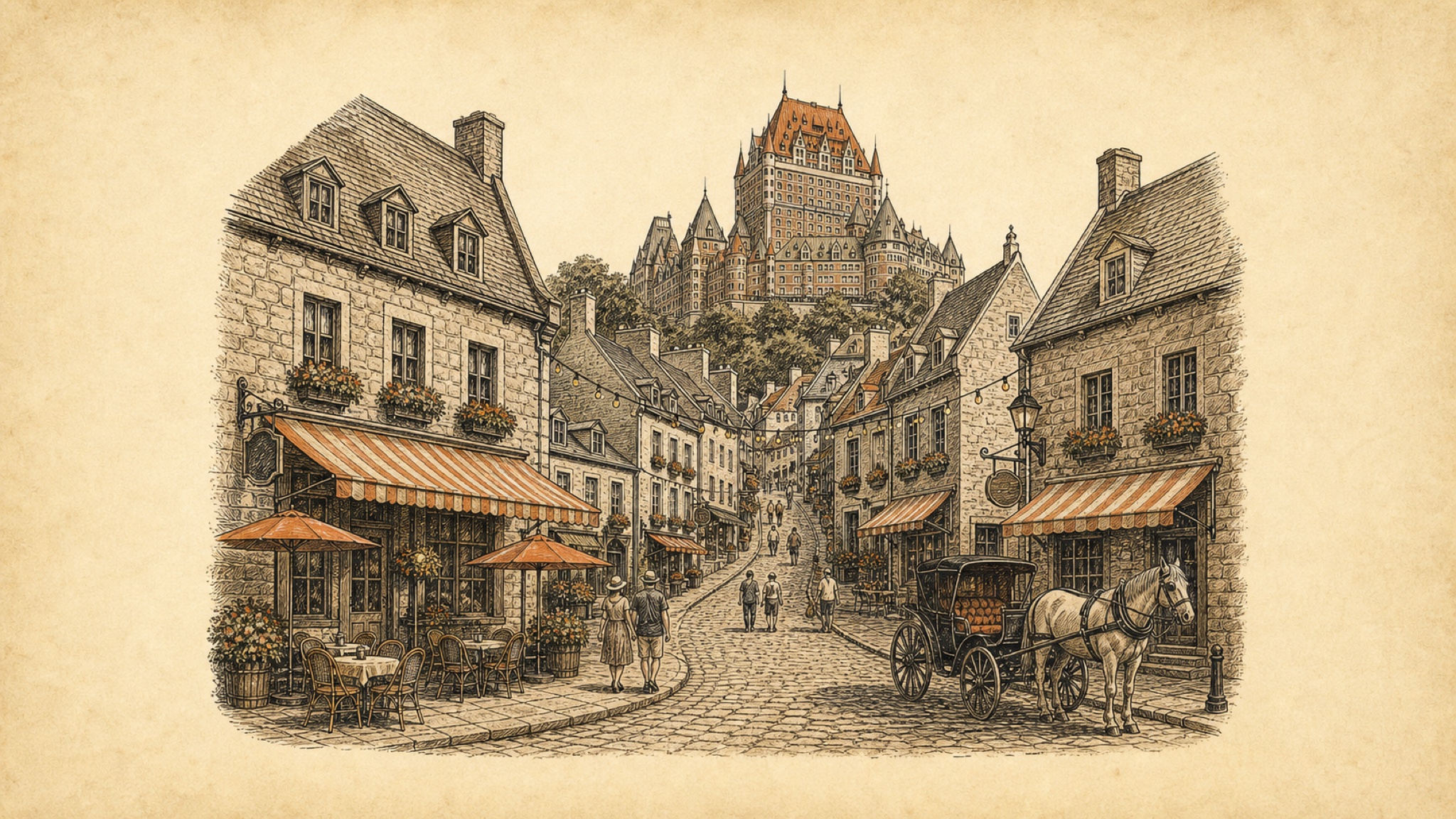
The stops on a history walk sit close together and are easy to find. Place Royale, the Lower Town square built on Champlain's original site, anchors the oldest part of the city. Nearby, the Quartier Petit-Champlain is a lane of narrow stone houses now filled with boutiques and cafés.
Above it all stands the Château Frontenac, the green-roofed hotel on the cliff. According to The Canadian Encyclopedia, Canadian Pacific began building it in 1892 to a design by the New York architect Bruce Price, and it was named a National Historic Site in 1981. Just beyond the walls lie the Plains of Abraham, where, as the Plains of Abraham park and The Canadian Encyclopedia describe, British and French armies under Generals James Wolfe and Louis-Joseph de Montcalm fought on September 13, 1759; both commanders were mortally wounded, and the city fell to the British days later. That single hour helped decide the future of New France. The park runs the battlefield as public green space today; you can check current hours and events on the Plains of Abraham official site.
Should you book a guided tour or walk it yourself?
It depends on your time, budget, and how much you want explained for you. A guided food tour bundles the logistics: someone books the tastings, walks you between them, and ties each dish to the streets around it. Booking platforms such as GetYourGuide and Viator list Old Quebec food tours running roughly three hours with ten or more small tastings, though the exact length, stops, and price vary by operator, so confirm the details on the listing before you pay.
Doing it yourself costs less and lets you linger. With Old Quebec's short distances, you can build a loop from Place Royale up to the Château and out to the walls, stopping at bakeries and cheese shops as you go. If you are watching what you spend across the whole trip, our guide to keeping daily travel costs in check pairs well with a self-guided day. A middle path also works: take a guided walk on your first morning to get your bearings, then return on your own to revisit the stops you liked.
Planning the walk: terrain, seasons, and simple courtesies
The one thing to prepare for is the hill. Old Quebec splits into Upper Town on the cliff and Lower Town by the river, linked by steep streets, the Escalier Casse-Cou (the "Breakneck Stairs"), and a funicular railway that spares your legs the climb. Wear shoes with grip; the cobblestones are uneven and turn slick when wet or icy.
Season shapes the visit more than anything else. Winters are long and cold, and the city leans into the season with the Québec Winter Carnival; summer brings warm days and the biggest crowds. Spring is sugar-shack time for maple. A few practical notes:
- Quebec City is majority French-speaking. A simple "bonjour" opens most doors, and many people in tourism also speak English.
- Book popular food tours ahead in summer and around festivals; small-group walks fill up.
- Leave a buffer between a tasting tour and your next meal or activity — three hours of grazing is filling and unhurried.
Combine the two threads and a plan falls into place on its own: start low at Place Royale for the oldest history, eat your way uphill through Petit-Champlain, and finish near the Château and the walls with the river spread out below. For opening times, festival dates, and neighborhood maps, the official tourism site at Destination Québec Cité is the steadiest source to check close to your trip.