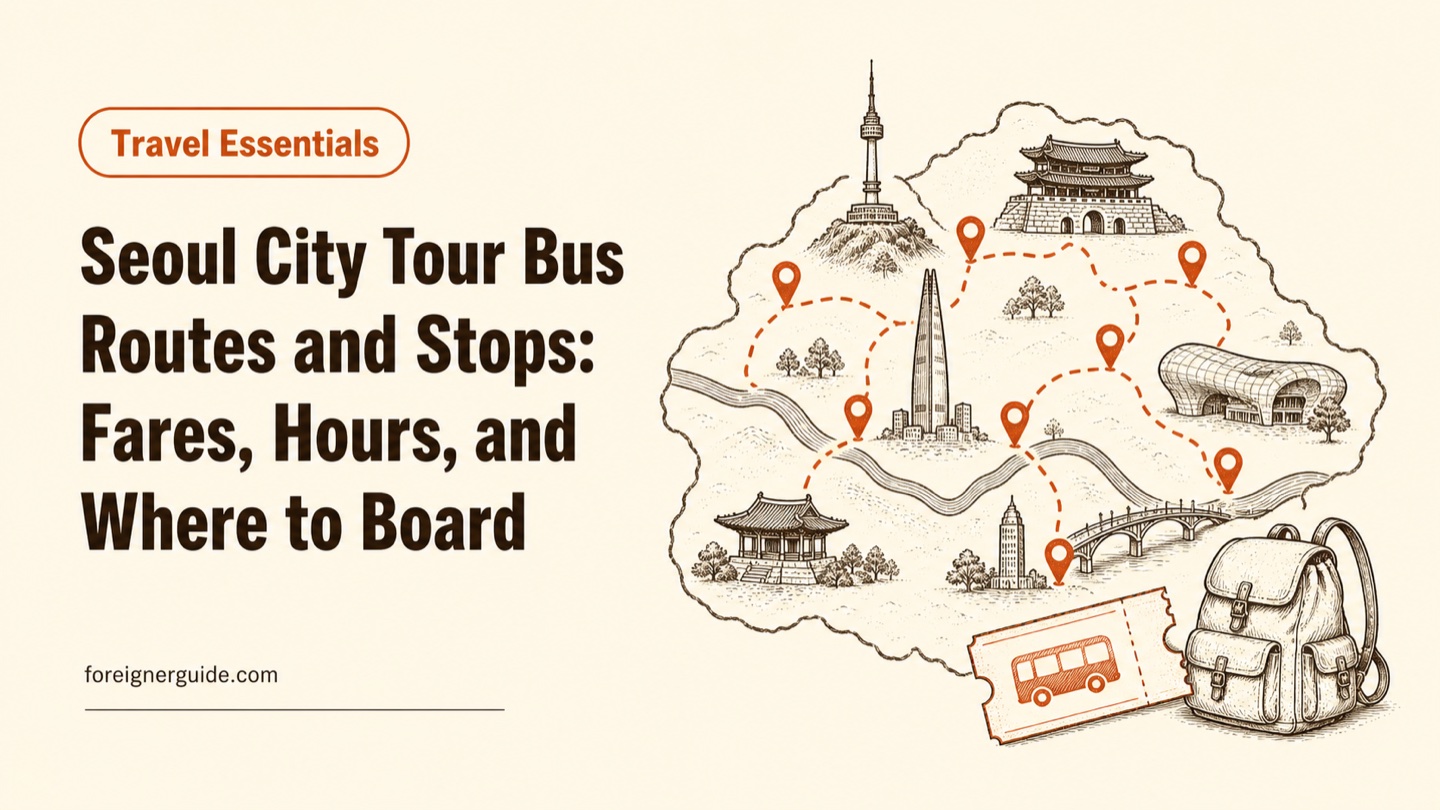
Seoul City Tour Bus Routes and Stops: Fares, Hours, and Where to Board
Seoul's hop-on hop-off tour buses loop the palaces, Myeong-dong, and Namsan for about KRW 24,000 a day, running Tuesday to Sunday from near Gwanghwamun.
Table of contents
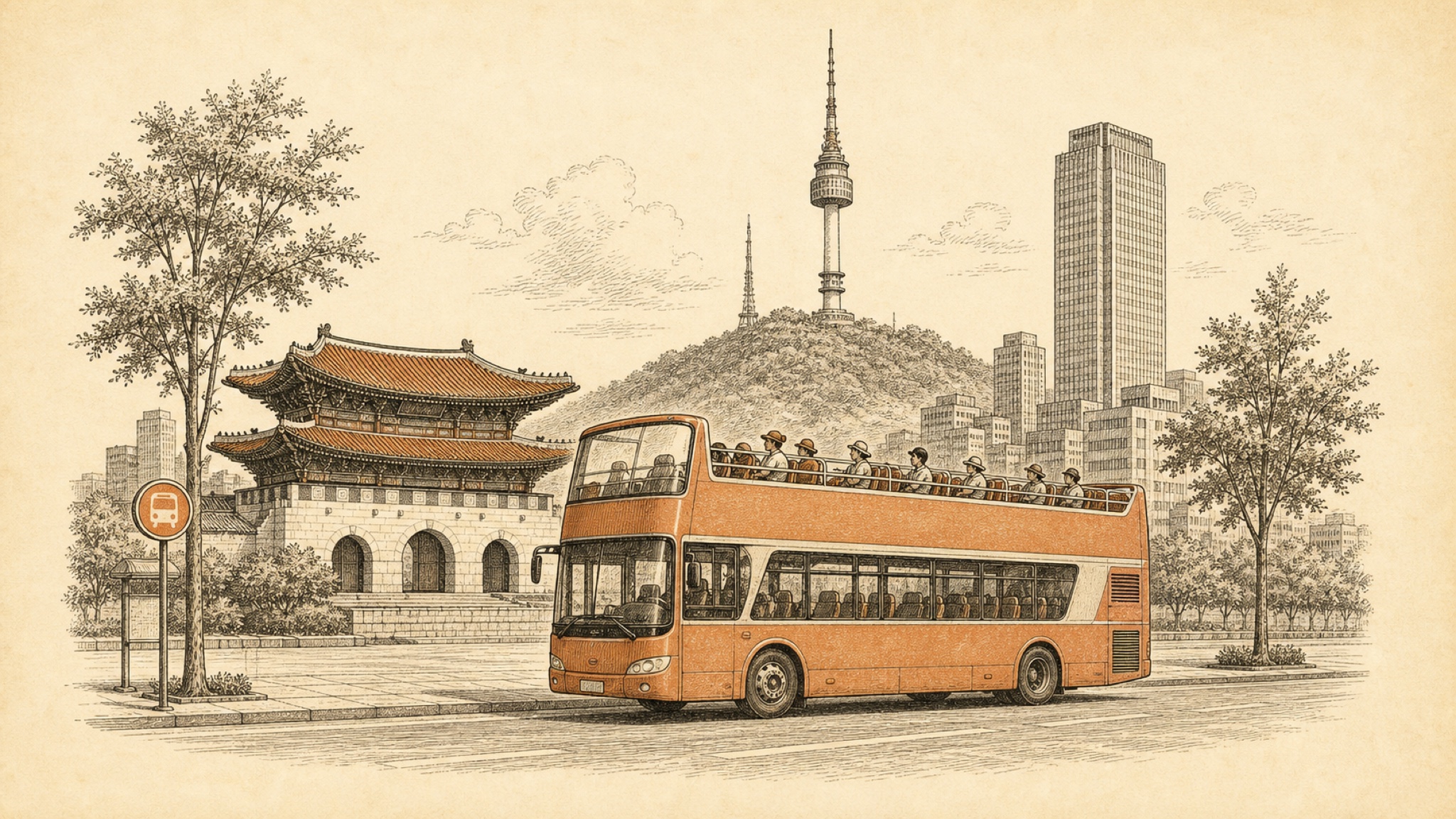
Seoul's city tour buses are hop-on hop-off sightseeing loops: you buy one ticket, then get on and off as often as you like at fixed stops beside the main sights. As of July 2026, the best-known daytime loop is the Downtown Palace Namsan course, a circular route that starts near Gwanghwamun and connects the royal palaces, Myeong-dong, Namdaemun Market, and Namsan with N Seoul Tower. Seoul's official Visit Seoul tourism site notes that these buses run every day except Monday, leave roughly every 30 minutes, and carry an onboard audio guide in about a dozen languages. This guide is for independent travelers riding the daytime routes in central Seoul; it does not cover private chartered tours, and because fares and timetables change, treat every figure here as a number to confirm on the operator's own site.
How does a hop-on hop-off tour bus work?
One ticket buys you a full day on the loop, not a single ride. The bus follows a fixed circular route and pulls in at numbered stops next to major attractions. You get off wherever you want, stay as long as you like, then catch a later bus with the same ticket and continue around the loop.
Every seat has audio commentary you listen to through headphones. According to Seoul's official Visit Seoul guide, the recording comes in 11 languages, including English, Japanese, Chinese, French, and Spanish, and the full circuit takes about an hour and 30 minutes if you never step off. The ticket is valid only for the day you buy it, so use it in one go rather than spreading it across your trip.
Which routes and stops does the bus cover?
Two separate companies both operate under the "Seoul City Tour Bus" name, which catches out many first-time visitors. The Tiger Bus (seoulcitybus.com) boards near Gwanghwamun in the historic center, while the Yellow Balloon bus (seoulcitytourbus.co.kr) starts from Dongdaemun. They are different operators with different tickets, so buy for the loop you actually plan to ride.
The Tiger Bus Downtown Palace Namsan course is the one most travelers choose. It links more than a dozen stops, among them Gwanghwamun and Gyeongbokgung Palace, Insadong, Namdaemun Market, Myeong-dong, Itaewon, the National Museum of Korea, and Namsan for N Seoul Tower. If you are also mapping out the palaces and other headline sights, our rundown of the main travel attractions across Korea lines up well with this route. Beyond the flagship loop, the Tiger operator also lists a Panorama course built around river and city views, an Around Gangnam course that boards at Gangnam Station, and an evening Night course that drives past the lit-up skyline without hop-off stops.
| Course | Boards near | Signature stops |
|---|---|---|
| Downtown Palace Namsan | Gwanghwamun | Gyeongbokgung, Insadong, Myeong-dong, N Seoul Tower |
| Panorama | Gwanghwamun | Namsan, Cheonggyecheon, Han River views |
| Around Gangnam | Gangnam Station | Gangnam Station area landmarks |
| Night course | Gwanghwamun | Lit skyline, ride-through only |
If your interest leans toward the south side of the river, the Gangnam course drops you near the districts we cover in our look at what you can actually visit on a K-pop agency tour.
How much is a ticket, and when does it run?
Expect roughly KRW 24,000 for an adult day pass on the main downtown loop. Seoul's official Visit Seoul guide lists the Tiger Bus City Palace Namsan and Panorama courses at KRW 24,000 for adults and KRW 15,000 for students and younger, while the Yellow Balloon operator's own fare page lists its Traditional Culture daytime course at KRW 27,000 for adults and KRW 20,000 for children. That same fare page defines the child rate as ages 48 months to 18, so infants and toddlers below that ride free.
On timing, the Visit Seoul guide says the Tiger Bus runs Tuesday through Sunday and closes on Mondays; when a Monday lands on a public holiday, the bus runs that day and takes the following day off instead. First departures are in the morning, around 9:30, and the last daytime loops leave in the late afternoon, so do not count on hopping aboard after dinner. Evening Night courses depart once in the early evening, around 7:30. Visit Seoul also notes that Discover Seoul Pass holders can ride the Tiger courses at no extra charge.
Where to board and how to plan your day
For the downtown loop, the main boarding point and ticket booth sit near the Donghwa Duty Free building at Gwanghwamun, a short walk from Gwanghwamun or City Hall subway stations. The Around Gangnam course boards at Gangnam Station Exit 11, and the Yellow Balloon bus starts from the Dongdaemun History and Culture Park area.
Pick three or four stops rather than trying to ride the whole loop and see everything in a day. A workable plan is one palace in the morning, a market or Myeong-dong for lunch, then Namsan and N Seoul Tower in the afternoon before the last bus. Bear in mind that several of Seoul's palaces close one day each week, and the closed day differs from palace to palace, so check each site's own schedule before you fix your order of stops. Traffic in the city center can stretch the gap between buses well past the posted 30 minutes, especially in the late afternoon.
Two operators, one name: avoid the mix-up
The most common mistake is buying the wrong bus. Because the Tiger Bus and the Yellow Balloon both market themselves as the Seoul City Tour Bus, and because resellers list similar routes at different prices, it is easy to end up holding a ticket for a loop that starts across town from where you are standing. Booking on the operator's official site, then matching the boarding point to your chosen route, heads off almost all of that trouble. You can compare the current courses and prices on Seoul's official Visit Seoul site, then confirm boarding points and timetables on the Tiger Bus operator's own site (seoulcitybus.com).