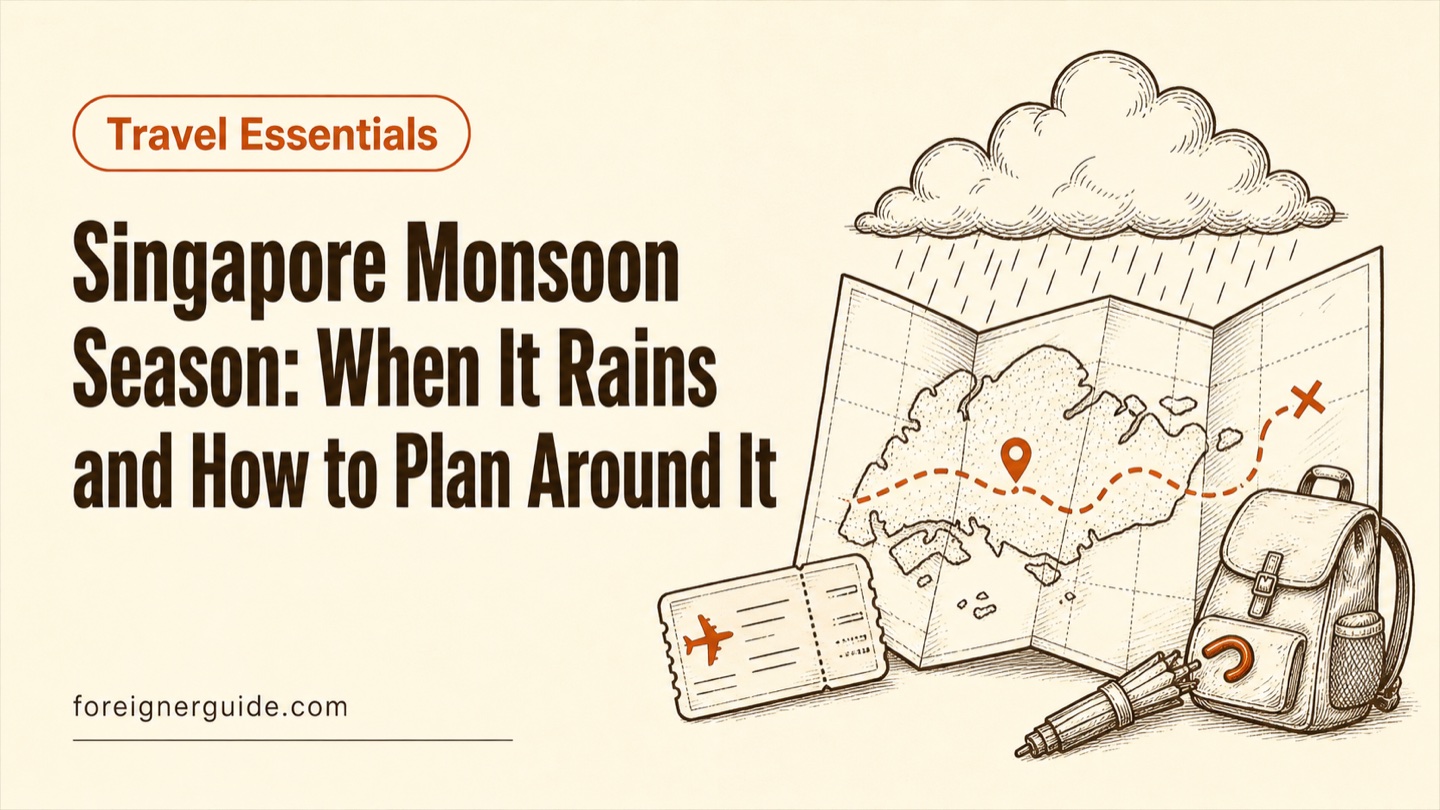
Singapore Monsoon Season: When It Rains and How to Plan Around It
Singapore's two monsoons: the Northeast (Dec–early March) is wettest, the Southwest (June–Sept) drier. When it rains and how to plan around it.
Table of contents
When is Singapore's monsoon season?
Singapore has two monsoon seasons: the Northeast Monsoon from December to early March, and the Southwest Monsoon from June to September. Between them fall two shorter inter-monsoon periods, roughly late March to May and October to November. Because Singapore sits almost on the Equator, it stays warm and humid all year with no true dry season — what shifts is the wind direction and how much rain falls, not the temperature.
The wettest stretch is the start of the Northeast Monsoon. The heaviest and most frequent rain runs from roughly November to January, which the Meteorological Service Singapore describes as the monsoon's wet phase, when the main tropical rain-belt lies near Singapore. The Meteorological Service Singapore's 1991–2020 climate figures put December as the wettest month at about 331.9 mm of rain, and February as the driest at about 105.1 mm, against a long-term average of 2,113.3 mm spread over roughly 171 rainy days a year. That sounds like a lot, and it is, but the rain tends to arrive in short heavy bursts rather than steady all-day drizzle. This guide explains the seasonal patterns you can plan around; it is not a substitute for the daily forecast, which you should still check close to your dates. Exact monsoon onset also shifts from year to year, so treat the windows above as guides rather than fixed dates.
| Period | Months | What to expect |
|---|---|---|
| Northeast Monsoon | December to early March | Wettest early on, then windy and drier by late February |
| Inter-monsoon | Late March–May, October–November | Light winds and afternoon thunderstorms |
| Southwest Monsoon | June to September | Drier overall, with occasional early-morning squalls |
The Northeast Monsoon and its wet phase
This is the season most visitors picture when they imagine rainy Singapore. The Meteorological Service Singapore describes it in two parts. The wet phase, from December to early January, brings what it calls monsoon surges — spells of stronger northeasterly wind that push in moderate to heavy rain, sometimes lasting a day or two at a time. The service typically counts two to four of these surge episodes in a single wet phase. From late January into early March the wind stays brisk but the rain eases off.
It is also the coolest time of year, though that is relative in the tropics. The Meteorological Service Singapore gives December and January a 24-hour average of about 26.8°C, only a degree or so below the May peak of 28.6°C. If you visit during these weeks, expect grey skies and downpours to interrupt your day, but rarely to cancel it. A flexible itinerary matters more here than in any other season.
The Southwest Monsoon (June to September)
Singapore is climatologically drier during the Southwest Monsoon, when the main tropical rain band sits well north of the Equator and the wind swings round to blow from the south and southeast. The Meteorological Service Singapore notes that this season brings occasional Sumatra squalls — fast-moving lines of thunderstorms that sweep in from the west, usually in the pre-dawn and early-morning hours, with wind gusts the service puts in the range of 40 to 80 km/h. A squall can be dramatic but is often over within an hour or two, leaving a clearer day behind. For travellers who want the least rain, these months are a reasonable bet.
The inter-monsoon months (April–May and October–November)
The inter-monsoon periods are the transition weeks between the two monsoons, and they behave differently from either one. With light and variable winds, heat builds through the day and releases as afternoon and early-evening thunderstorms, often with vivid lightning. The Meteorological Service Singapore notes that the October–November inter-monsoon is generally wetter than the earlier one in March–May. The rhythm is fairly predictable: mornings are frequently bright, and the storms roll in later, so front-loading your outdoor plans works well.
Does it rain all day during the monsoon?
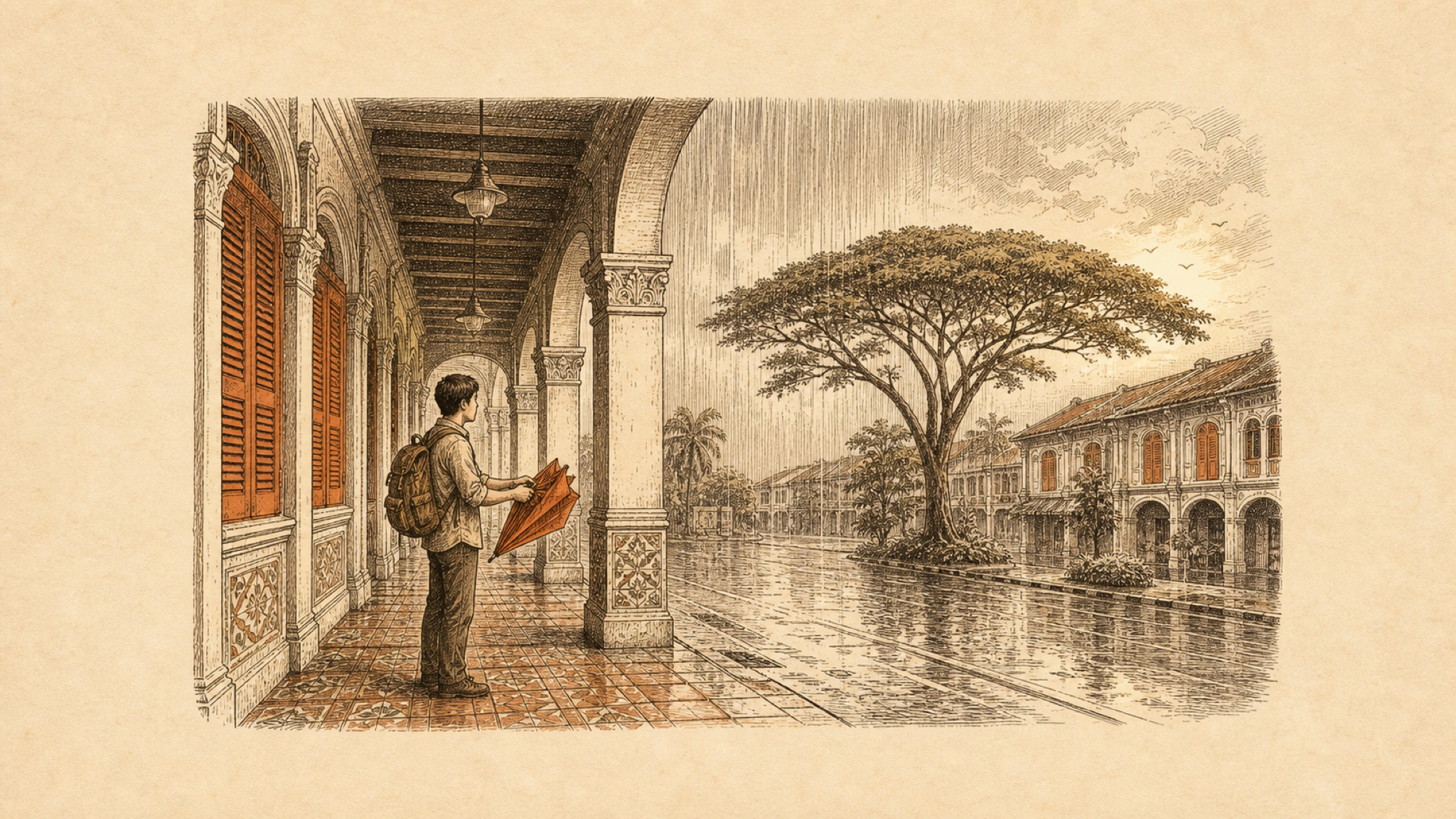
Usually not. Even in the wettest weeks, Singapore's rain tends to come as short bursts of moderate to heavy showers, most often in the afternoon and evening, rather than a constant grey soak. The figure of roughly 171 rain days a year from the Meteorological Service Singapore counts any day with measurable rainfall, so a ten-minute shower and a daylong downpour each count as one. You can genuinely see heavy rain and clear sky in the same afternoon. The steadier companion is the humidity: the service puts the mean annual relative humidity at around 82%, with mornings often above 90%.
How to plan a trip around the rain
Singapore is built for wet weather, so a monsoon visit is about preparing rather than avoiding. A few habits go a long way:
- Pack a compact umbrella and quick-dry clothing rather than a heavy raincoat — temperatures sit around 23–25°C at night and 31–33°C by day, so a poncho turns sweaty fast.
- Do outdoor plans such as Gardens by the Bay, the zoo, or Sentosa in the morning, and keep indoor options like museums, malls, and hawker centres ready for the afternoon storm window.
- Lean on the MRT and Singapore's sheltered walkways; much of the central city connects under cover, so you can move between places without getting soaked.
- Book refundable or flexible where you can during December and January, the peak rain weeks, and build slack into any single-day outdoor highlight.
Timing matters for crowds as well as rain. Chinese New Year in 2027 falls on February 6 and 7 — a major regional travel period when hotels across Singapore tend to be pricier and some smaller shops and eateries close for the holiday. It is a crowd-and-cost consideration layered on top of the year-round humidity rather than the rain itself.
If you are weighing when to go against everything else — flights, budget, and paperwork — our guide on planning a trip abroad covers how to balance season against cost. For live conditions and monsoon advisories before and during your trip, the Meteorological Service Singapore publishes daily forecasts and monsoon updates.