What Is a Digital Nomad? The Lifestyle, the Rules, and What It Takes
A digital nomad works online while living in changing places. What the term means, how it differs from remote work and expat life, and what it takes to start.
Table of contents
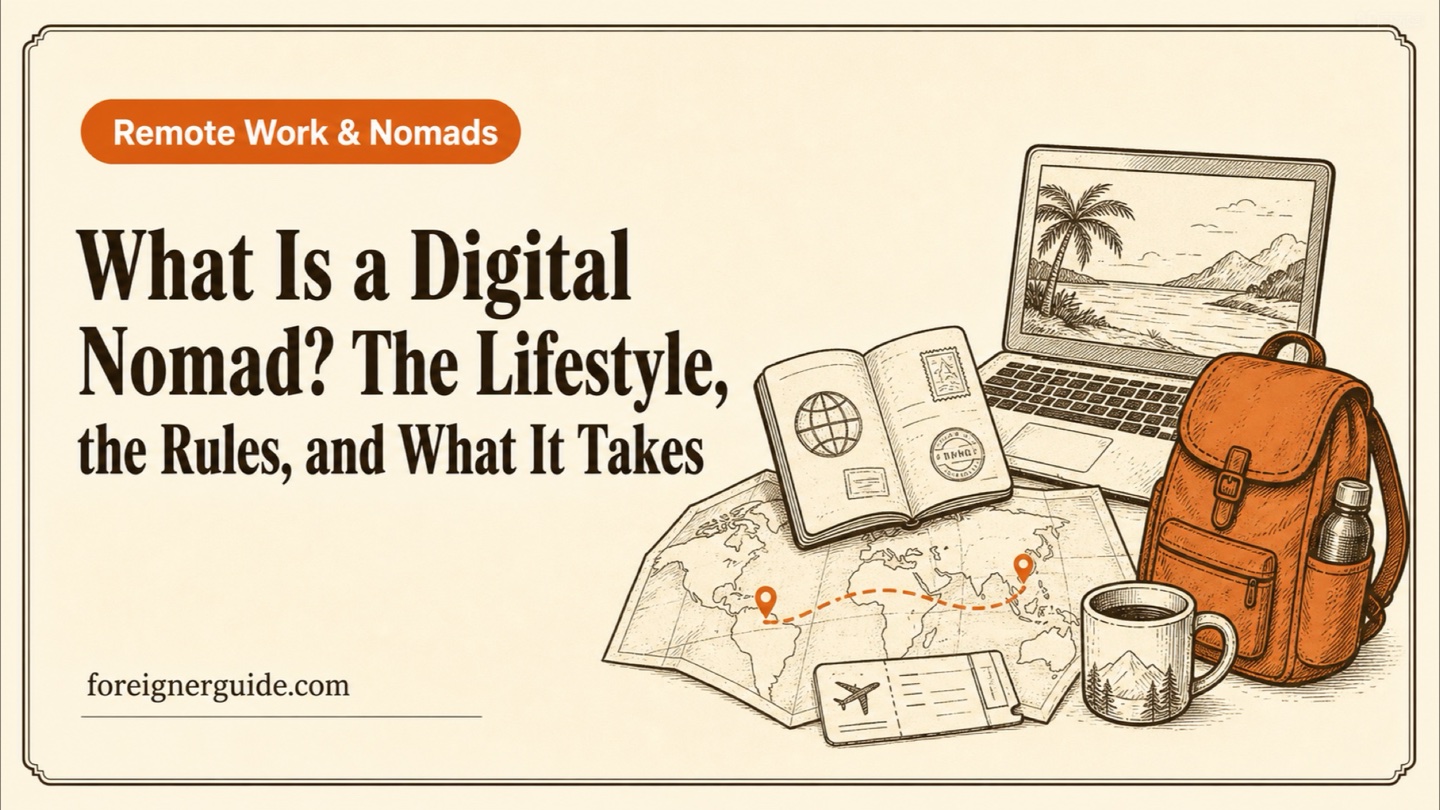
A digital nomad is someone who earns money through work they can do over the internet — usually a freelancer, a remote employee, or an online business owner — while living in different places instead of from one fixed home. The defining traits are simple: the work happens entirely online, and there is no permanent, fixed address. Put simply, the job travels with the laptop and the address keeps changing.
This guide covers what the phrase means, where it came from, how nomads differ from ordinary remote workers and expats, and what it practically takes to live this way. It is written for travelers and people weighing a move abroad, and it is general information rather than legal, tax, or financial advice. The idea itself is decades old, but the visa programs and headline numbers around it shift from year to year, so the figures below are current as of mid-2026.
Where the term "digital nomad" comes from
The phrase dates back to 1997, when technologist Tsugio Makimoto and journalist David Manners published a book called "Digital Nomad." Their argument was that as computers and communications kept shrinking, work would stop being tied to a single office, and many people would drift back toward a more mobile way of living. For years the label stayed niche. Cheaper laptops, widespread mobile data, and the normalization of remote work after 2020 turned that forecast into a lifestyle you can now recognize on any coworking-cafe wall.
How is a digital nomad different from a remote worker?
A digital nomad is a remote worker who also keeps moving; a plain remote worker usually stays put. That overlap causes most of the confusion, so it helps to line up the nearby terms side by side.
| Term | Works online | Changes location | Typical base |
|---|---|---|---|
| Remote worker | Yes | Rarely | One home |
| Digital nomad | Yes | Often | No fixed home |
| Expat | Not always | No | One country abroad |
| Tourist | No | Yes | A home they return to |
An expat — short for expatriate, meaning someone who lives outside their home country — might hold a local job and never work online at all. A tourist travels but does not earn income from the road. A digital nomad combines both: online income and frequent relocation.
How common the lifestyle has become
It is far more common than it was a decade ago, at least in the United States, where the clearest yearly count comes from the workforce firm MBO Partners. Its 2024 Digital Nomads report found that 18.1 million American workers described themselves as digital nomads — about 11% of the U.S. workforce — a rise of more than 147% since 2019. The same report put Gen Z and Millennials together at roughly 64% of the total. Those figures track American workers specifically; global counts are harder to pin down, because definitions and survey methods differ from one country to the next.
Can you legally work from any country you visit?
Not automatically. A standard tourist entry usually lets you visit, not work, even when your employer and clients are back home, and the rules vary by country and by your nationality. To close that gap, dozens of countries now issue a dedicated digital nomad visa — a permit that lets you stay for months or a year or more while working for foreign employers or clients. If a specific destination is on your mind, our guide to how these visas handle income rules, taxes, and applications walks through the process in more detail.
Requirements differ widely from one program to the next. According to 2026 comparisons published by immigration and tax-advisory firms that track these visas, monthly income thresholds for European programs commonly fall somewhere between roughly €2,800 and €4,500, with Spain toward the lower end and Estonia toward the higher one. Spain, for one, ties its threshold to a multiple of the national minimum wage rather than a flat figure. Taxes are a separate question from immigration: how much you owe, and where, usually depends on how many days you spend in a place and on your tax residency — exactly the kind of detail worth confirming with a professional before you commit.
What it takes to get started
Becoming a digital nomad mostly means lining up a few pieces so you can leave without stranding yourself. In rough order:
- Income you can fully earn online — remote employment, freelance clients, or a business that runs from a laptop — ideally proven over several months before you depend on it abroad.
- A legal basis for each country you stay in, whether that is a nomad visa, another residence permit, or a stay short enough to fall within tourist rules.
- Health and travel insurance that genuinely covers you outside your home country, including longer stays rather than only short trips.
- Banking that works across borders, so you can get paid and spend without cards being frozen; sorting out how to open a bank account abroad ahead of a move saves a lot of friction.
- A dependable place to work, which in practice means checking internet speed and the time-zone overlap with your team or clients before you book a long stay.
A realistic look before you commit
The lifestyle sells itself on beaches and freedom, but the day-to-day is ordinary work done in unfamiliar places. The common trade-offs are time-zone gaps that push calls into the night, the paperwork load of visas and taxes, routines that fray on the road, and stretches of loneliness when you move faster than you make friends. None of that is a reason to skip it. It is a reason to start slowly — a few weeks in one city rather than a one-way ticket around the world — and to treat the first months as a test, not a permanent identity.