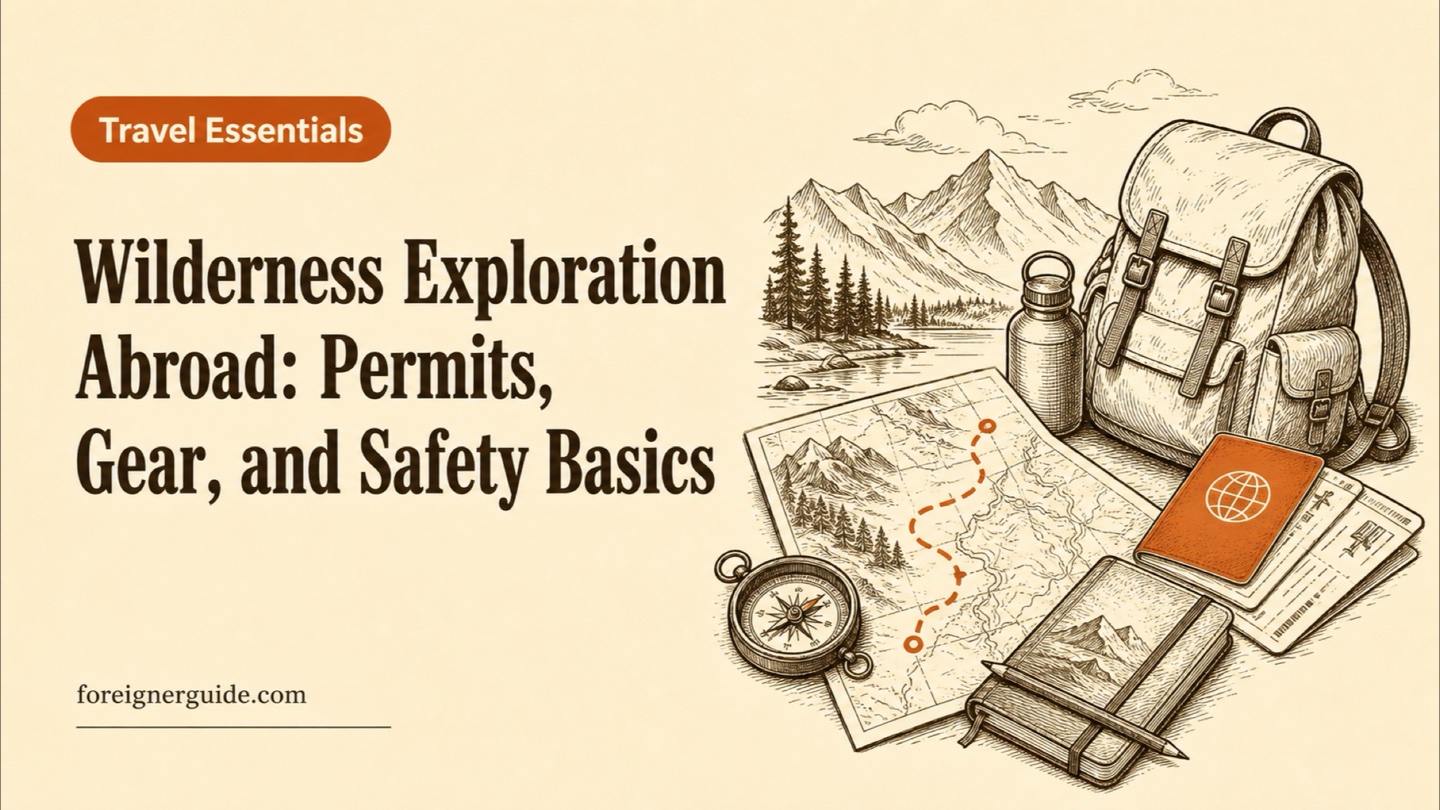
Wilderness Exploration Abroad: Permits, Gear, and Safety Basics
A practical guide to wilderness trips abroad: how backcountry permits work, the Ten Essentials gear systems, and how a PLB calls for help off-grid.
Table of contents
Wilderness exploration means traveling under your own power into land beyond roads, marked trailheads, and services: a national park's backcountry, an alpine pass, a desert canyon, or a long-distance trail. If you are planning one abroad, three things decide whether it goes smoothly: a permit if the area needs one, the right gear, and a reliable way to call for help. As of July 2026, popular backcountry permits in the United States are booked through Recreation.gov, personal locator beacons are registered for free with NOAA, and both the Leave No Trace Center for Outdoor Ethics and the U.S. National Park Service publish the low-impact habits that keep these places open.
This guide covers general planning for protected wilderness and backcountry areas: permits, gear, and emergency communication, written for independent travelers. It is general information, not legal, medical, or destination-specific regulatory advice. Rules, fees, and dates differ by country and by park, so confirm the current details for wherever you are headed.
What counts as wilderness exploration?
In plain terms, it is travel into land left mostly undeveloped, where you carry what you need and there is little or no infrastructure to fall back on. The word also has a legal meaning in some places. In the United States, the Wilderness Act of 1964 created the National Wilderness Preservation System, a network of federally protected areas where roads, motor vehicles, and permanent structures are largely barred. Other countries use their own labels, such as national parks, nature reserves, or conservation areas, each with its own rules about where you can walk, camp, and light a fire.
For a traveler, the practical line is simple. Once you leave the day-use zones with parking lots, ranger desks, and cell coverage, you are in the backcountry (areas away from roads and services), and you plan differently. That means checking whether the area needs a permit, packing to be self-sufficient for the length of the trip plus a margin, and telling someone your route and return time before you lose signal.
Do you need a permit to explore the backcountry?
Often yes, especially for overnight trips in popular parks, and you usually reserve it weeks ahead. In the United States, most national-park wilderness permits are issued through Recreation.gov, the federal booking site. Many parks split their permits between advance online reservations and walk-up slots held for people who show up in person. The National Park Service says Mount Rainier releases roughly two-thirds of its backcountry permits online and holds about one-third for in-person requests, while North Cascades reserves about 60 percent online and keeps 40 percent for walk-up visitors.
Timing is the part travelers underestimate. According to Recreation.gov, Yosemite's wilderness permit reservations open from 24 weeks down to three days before your entry date during the busy season of roughly late April through mid-October, and outside those dates a self-registration permit is still required. Sought-after permits can sell out within minutes of release, and some parks assign them by lottery rather than first-come booking. Build your plan around the release date, not your travel date, and keep a backup trailhead in mind.
The gear systems that keep a trip from going wrong
The most widely used checklist is the Ten Essentials. The Mountaineers, the climbing organization behind the guidebook Mountaineering: The Freedom of the Hills, formalized the list in that book's 1974 third edition and now frames it as ten systems rather than ten single items. The U.S. National Park Service publishes the same framework. The idea is to carry what lets you handle a night out, a wrong turn, or an injury without outside help:
- Navigation: a topographic map (a map that shows elevation as contour lines), a compass, and a GPS device or phone app.
- Sun protection: sunglasses, sunscreen, and clothing that covers skin.
- Insulation: extra layers for the coldest, wettest conditions you might hit.
- Illumination: a headlamp, plus spare batteries.
- First-aid supplies.
- Fire: a lighter or matches and a firestarter.
- Repair kit and tools, including a knife.
- Nutrition: extra food beyond your planned meals.
- Hydration: extra water and a way to treat more.
- Emergency shelter: a bivy sack, tarp, or space blanket.
You do not need the most expensive version of each. You need one working item for every system and the judgment to turn back before you need all ten at once.
How do you call for help without a cell signal?
You carry a device that reaches satellites instead of cell towers, and there are two main kinds. A personal locator beacon, or PLB, is a small device that sends a one-way emergency signal to the government-run COSPAS-SARSAT search-and-rescue satellite network. NOAA's beacon registration program states that registering a 406 MHz beacon is free, required by U.S. law, and must be renewed every two years, with no subscription fee to own or use it. A satellite messenger, such as a Garmin inReach, adds two-way texting, location tracking, and an SOS button, but it runs on a commercial network and needs a paid plan. Garmin's published pricing lists inReach plans starting around US$12 to US$15 per month depending on the tier, and Garmin says pressing SOS reaches Garmin Response, its staffed emergency coordination center.
| Feature | Personal locator beacon | Satellite messenger |
|---|---|---|
| Signal | One-way SOS only | Two-way texting plus SOS |
| Network | Government COSPAS-SARSAT | Commercial (e.g., Iridium) |
| Subscription | None | Required, roughly US$12 to $15+ per month |
| Registration | Free with NOAA, renew every 2 years | Account with the provider |
| Best for | Emergency-only backup at lowest cost | Staying in touch and sending an SOS |
Either one can save your life, and neither replaces telling a friend your itinerary. If you already own a beacon, check that its registration is current before you fly. An unregistered signal slows the response, because rescuers cannot tell who or what they are looking for.
Leave No Trace, and why it protects your access
Access to wild places tends to tighten after damage, so the habits that keep them intact are also what keep them open to visitors. The Leave No Trace Center for Outdoor Ethics, a nonprofit formed in 1994, and the U.S. National Park Service both publish seven principles for low-impact travel:
- Plan ahead and prepare.
- Travel and camp on durable surfaces.
- Dispose of waste properly, and pack out what you pack in.
- Leave what you find.
- Minimize campfire impacts.
- Respect wildlife.
- Be considerate of other visitors.
These are not abstract. In many alpine and desert areas, that means carrying out all trash and human waste, staying on the trail instead of cutting switchbacks, and keeping a respectful distance from animals rather than feeding them. You can read the full principles on the Leave No Trace site at lnt.org.
A short pre-trip checklist
Wilderness trips reward planning far more than improvisation. A few weeks out, work through the basics in order:
- Confirm whether your route needs a permit and when reservations open. For U.S. parks that is Recreation.gov; elsewhere, check the managing park or agency directly.
- Sort out entry rules for the country itself, because a hiking trip is still an international trip. Our guide to what to confirm about travel visas before you book covers the paperwork side.
- Check what your insurance actually pays for. Search-and-rescue, helicopter evacuation, and remote medical care are common exclusions, which we break down in the coverage gaps to check in tourist travel insurance.
- Pack the Ten Essentials, and register any 406 MHz beacon at NOAA's beacon registration site if you are carrying one.
- Leave a written itinerary and expected return time with someone who will notice if you are late.
None of this is about fear. It is the ordinary discipline that lets you enjoy the quiet, the distance, and the scale of a place while keeping the trip firmly within your control.