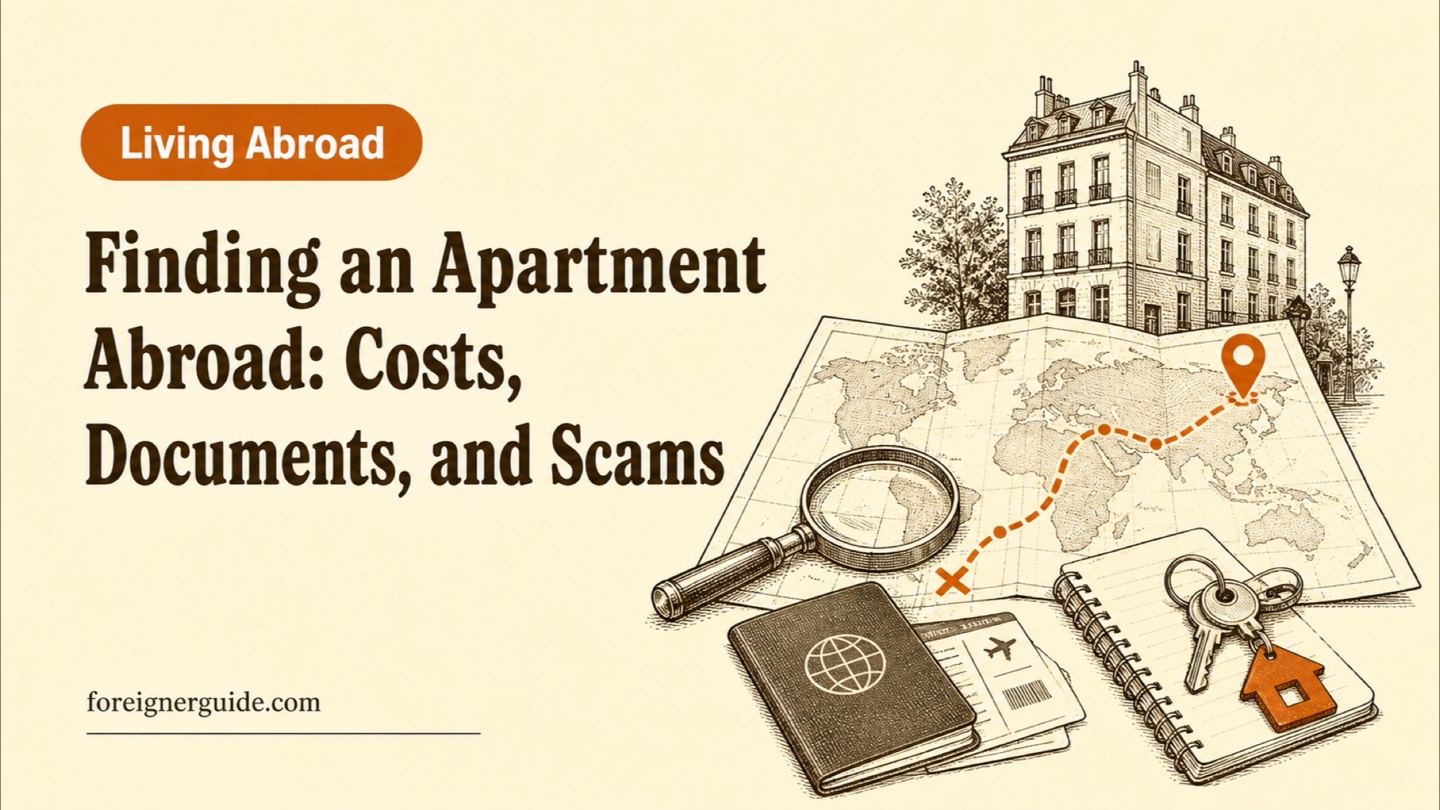
Finding an Apartment Abroad: Costs, Documents, and Scams
Find a rental abroad the safe way: use local listing sites, budget for deposits and key money that can top three months' rent, and never pay before you view.
Table of contents
Finding an apartment abroad comes down to four moves: search on the rental site locals actually use, budget for upfront costs that can run far past a single month's rent, get your documents ready before you apply, and never send money before you have seen the place in person or on a live video call. As of July 2026, the deposit caps and key-money customs described below reflect common rules and practice, but figures change by country and city, so confirm the exact numbers for where you are moving before you sign anything.
Two authorities anchor the money and safety advice here: Germany's Civil Code sets a hard legal limit on rental deposits, and the U.S. Federal Trade Commission publishes plain guidance on spotting rental scams. This is general information for people renting long-term while living or working abroad, not legal or financial advice. It does not cover short holiday stays or buying property.
Start where locals actually search
The listings you find on a global English-language site are usually a thin slice of what is really available. Most countries have one or two dominant local portals where landlords and agents post first, and the prices there tend to reflect the real market rather than a newcomer premium.
A few of the market leaders by country:
- Spain, Portugal, and Italy: Idealista, which carries rental and sale listings across southern Europe.
- Germany: ImmobilienScout24, the country's largest rental portal.
- Netherlands: Funda, the site Dutch renters and buyers check by default.
- Japan: SUUMO, one of the main property search sites, though many rentals still run through local agents.
If you do not read the local language yet, browser translation handles most listing pages well enough to shortlist, and platforms built for international renters can bridge your first few months. Treat the local portal as your source of truth for what a fair rent looks like.
How much money do you need up front?
Often far more than one month's rent. In some countries the total to move in reaches the equivalent of four to six months of rent once you add deposits, agency fees, and the first month. The pieces vary a lot by country.
Germany's Civil Code (the BGB) caps a security deposit at three months' "cold rent," meaning the base rent without heating and utility charges, and it gives tenants the right to pay that deposit in three equal monthly installments. You can read the official English translation on the German Federal Ministry of Justice's law portal.
Japan works differently. On top of the first month's rent, city landlords often charge two separate sums: shikikin, a refundable security deposit, and reikin, or key money, a non-refundable gift to the landlord that you do not get back when you leave. Each is commonly one to two months' rent, and with an agency fee and a guarantee-company charge added, move-in costs in cities like Tokyo, Kyoto, and Osaka can climb to several months of rent at once. Japan's Urban Renaissance Agency (UR), a semi-public housing operator, does not charge key money or renewal fees on its properties, which is one way renters trim the opening bill.
| Country | Typical deposit | Other upfront costs to expect |
|---|---|---|
| Germany | Up to 3 months' cold rent, capped by law | First month's rent; agent fee in some cases |
| Japan | 1 to 2 months (shikikin, refundable) | Key money (reikin, non-refundable), agency and guarantor fees |
| France | Commonly about 1 month (unfurnished) | Agency fee; income proof near 3x the rent |
France sits between the two extremes. Landlords there commonly want to see that your income is around three times the monthly rent before they accept you, and the deposit on an unfurnished place is often about one month. Wherever you land, ask for the full move-in figure in writing, with the deposit, fees, and first month added together, so nothing surprises you at signing.
The documents landlords will ask for
Gather these before you find a place you love, because good apartments move fast and the applicant with a complete file usually wins. Expect to show most of the following:
- A valid passport or national ID.
- Proof that you can legally stay: a visa, residence permit, or work authorization covering the lease term.
- Proof of income, often your last three payslips, or business records if you are self-employed.
- Recent bank statements.
- In some countries, a guarantor: a person or a paid guarantee company that agrees to cover the rent if you cannot.
Landlords in many places also prefer tenants with a local bank account, which is one reason it helps to open a bank account abroad before and after you move rather than waiting until the lease is signed. If your documents are in another language, ask early whether the landlord needs certified translations, since that can add days to your timeline.
How do you spot a rental scam from abroad?
Watch for anyone who wants money before you have seen the property and who refuses a real viewing. The U.S. Federal Trade Commission warns renters never to pay a deposit, application fee, or first month's rent before touring the place and signing a lease, and to be suspicious of "owners" who claim to be out of the country and so cannot show it. The agency's full guidance is on its rental listing scams page.
A few concrete red flags:
- Rent priced well below similar apartments nearby, paired with pressure to decide fast.
- A request to pay by wire transfer, gift card, or cryptocurrency, which are almost impossible to trace or reverse.
- A listing whose owner will not offer an in-person or live video walkthrough of the actual unit.
- The same photos or address showing up under a different name elsewhere online. Search the address together with the owner's name; duplicate ads with different contacts are a strong sign of fraud.
When you cannot fly out to view a place first, a live video call where the person walks through that specific apartment, not a recorded clip, is the safest substitute. Pay the deposit only by traceable bank transfer after a lease is signed, and keep every message and receipt.
A steady order of operations
Apartment hunting from another country feels calmer when you run it in the same sequence each time:
- Set your budget as the full move-in total (deposit, fees, and first month), not just the monthly rent.
- Shortlist on the country's main local portal so your sense of a fair price is accurate.
- Prepare your document file early: ID, proof of income, bank statements, and a guarantor if the country needs one.
- Insist on a live viewing before any payment.
- Sign a written lease and pay the deposit only by traceable transfer.
None of this removes the ordinary stress of moving, but it keeps the two things that go wrong most often, hidden upfront costs and scams, from catching you off guard. Once the keys are yours, the harder adjustment is usually settling into daily life in a new country, and that is a much better problem to have.