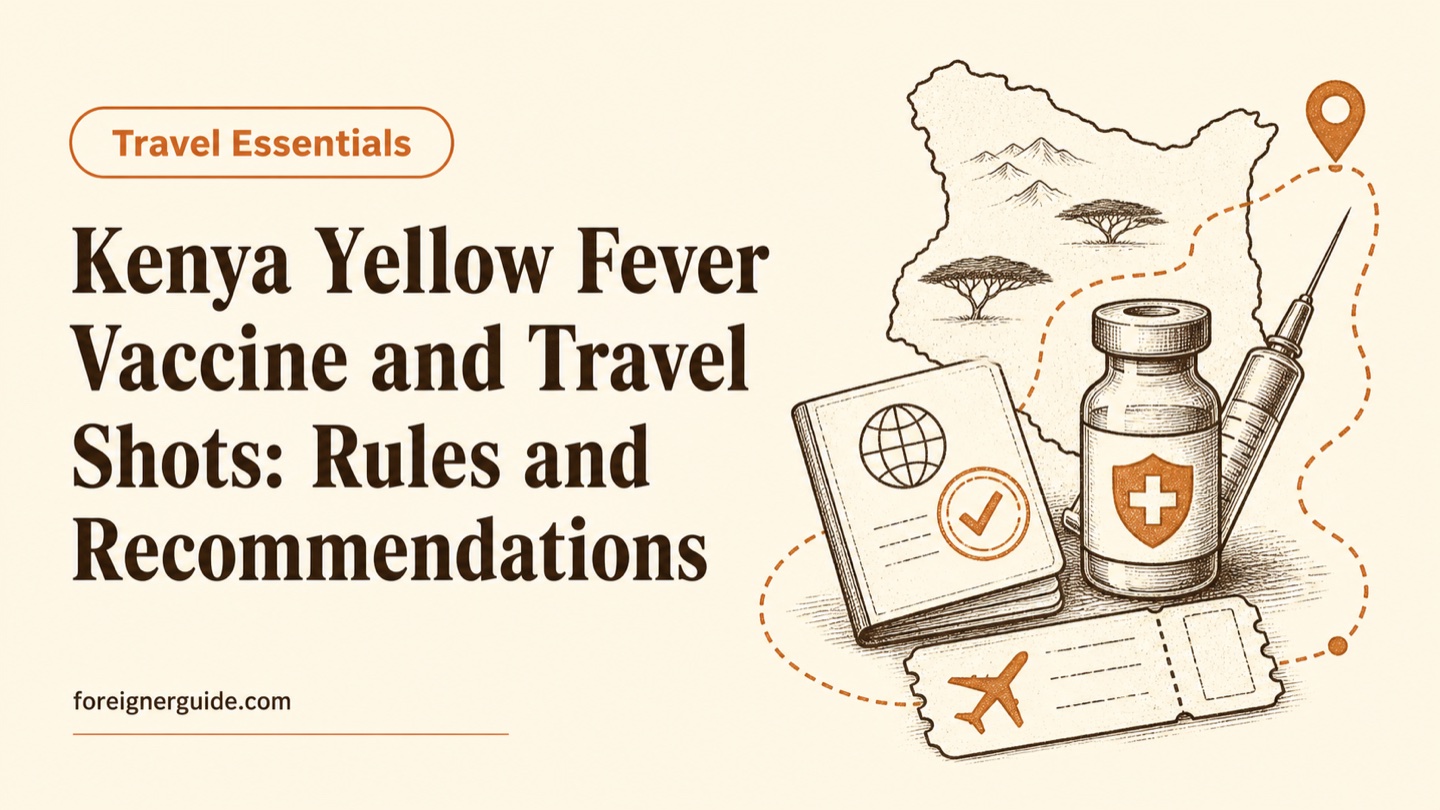
Kenya Yellow Fever Vaccine and Travel Shots: Rules and Recommendations
Whether Kenya requires a yellow fever certificate depends on where you fly from. The CDC still recommends the shot for most safari trips, plus other vaccines.
Table of contents
Whether you need a yellow fever shot to enter Kenya comes down to one thing: where you are flying from. As of July 2026, the U.S. Centers for Disease Control and Prevention (CDC) states that travelers arriving directly from a country with no yellow fever risk — the United States, the United Kingdom, Canada, and most of Europe — do not have to show proof of vaccination at the Kenyan border. Travelers arriving from, or who spent more than 12 hours in transit through, a country where yellow fever spreads must carry a valid certificate if they are 1 year or older. Separately from that entry rule, the CDC still recommends the vaccine for most people visiting Kenya's safari regions. This guide covers leisure and business travelers planning a trip of a few weeks or less; it is general information, not medical advice, and your own doctor or a travel clinic makes the final call based on your health and route.
Do you need a yellow fever shot to enter Kenya?
Only if you are coming from a place where yellow fever is present. This is the point most travelers get wrong, because two different things share the same vaccine. The first is Kenya's legal entry requirement, which follows the International Health Regulations and looks at your travel history. The second is the CDC's health recommendation, which looks at where inside Kenya you are going. You can be exempt from the border rule and still be advised to get the shot for your own protection.
Here is how the entry requirement breaks down by where your trip starts:
| Your route into Kenya | Yellow fever certificate at the border |
|---|---|
| Direct from the US, UK, Canada, or most of Europe | Not required |
| Arriving from a country with yellow fever risk | Required, age 1 and older |
| Transited over 12 hours in a yellow-fever-risk country | Required, age 1 and older |
A common trap is a layover. If your flight to Nairobi connects through a yellow-fever-risk country and your stopover runs long, you can trigger the certificate rule even though your journey began somewhere low-risk. Check the airport code and layover length on your itinerary before you assume you are exempt.
What the CDC recommends inside Kenya
The CDC recommends the yellow fever vaccine for most travelers aged 9 months and older going to Kenya, and it names the places where it does not. According to the CDC's Kenya destination page, the shot is generally not needed if your trip stays within Nairobi city, the former North Eastern Province counties of Mandera, Wajir, and Garissa, or most of the former Coast Province — Kilifi (including Malindi), Kwale, Lamu, Mombasa, and Tana River. The one exception in that coastal group is Taita-Taveta County, where the vaccine is recommended. In plain terms: a beach-only trip to Mombasa or Diani sits in the low-risk zone, while a classic safari through the Rift Valley or the Maasai Mara does not. You can read the full country guidance on the CDC Travelers' Health page for Kenya.
How the yellow card certificate works
The proof of vaccination is a paper document called the International Certificate of Vaccination or Prophylaxis (ICVP), better known as the yellow card because of its color. A clinic authorized to give the yellow fever vaccine stamps and signs it. Two timing details matter. First, the certificate does not count the moment you get the shot — the CDC notes it becomes valid 10 days after the vaccination date, so a same-week appointment before departure is too late. Second, you almost certainly never need a booster. The World Health Organization amended the International Health Regulations in July 2016 so that a single dose is valid for the life of the person vaccinated, and older certificates that show a 10-year expiry are still accepted as lifelong. Keep the yellow card with your passport, because border officials ask for the physical document, not a photo.

Is there a shot for malaria in Kenya?
No — for travelers there is no malaria vaccine, so protection means prescription pills plus avoiding bites. The CDC says malaria spreads in Kenya at elevations below about 2,500 metres (8,200 feet), which includes most game parks, while central Nairobi carries only rare cases and calls for bite precautions rather than pills. Kenya's malaria is resistant to chloroquine, so that old drug is not used here. The CDC lists atovaquone-proguanil, doxycycline, mefloquine, and tafenoquine as options, and the right one depends on your health, trip length, and budget. Fill the prescription at home before you leave and bring enough for the whole trip, since some of these medicines have to start days before you arrive and continue after you return. Bite prevention still matters on top of pills: repellent with DEET or picaridin, long sleeves at dusk, and a room with screens or a treated bed net.
Which other travel shots should you plan?
Beyond yellow fever, the CDC lists a handful of vaccines to sort out before Kenya. Most are routine ones you may already have; a few are trip-specific. A travel clinic reviews your record and fills the gaps.
- Routine vaccines — measles-mumps-rubella (MMR), diphtheria-tetanus-pertussis, polio, chickenpox, and a seasonal flu shot, all up to date.
- Hepatitis A — recommended for travelers because you can catch it through contaminated food or water.
- Typhoid — worth it especially if you will eat outside major hotels, visit rural areas, or stay with friends or relatives.
- Hepatitis B — recommended for unvaccinated travelers, particularly under age 60.
- Rabies — considered for longer stays, rural travel, or trips involving close animal contact.
- Meningococcal — relevant if you head into the meningitis belt, the band of sub-Saharan Africa where these outbreaks peak in the dry season.
Vaccines and pills do not cover the cost of treatment if you do get sick abroad, so it is worth checking that your medical coverage travels with you — our guide to travel insurance coverage and the gaps to check walks through what a typical policy leaves out.
When to book your travel-health appointment
Book about four to six weeks out. The CDC advises seeing a doctor or travel clinic at least a month before you leave, and Kenya is a good example of why. The yellow fever certificate only takes effect 10 days after the shot, hepatitis A and typhoid protection needs time to build, and some malaria pills start before departure. Leaving it to the final week can mean an invalid yellow card at check-in. Call ahead too — not every clinic or pharmacy is authorized to give the yellow fever vaccine and issue the stamped certificate, and some carry it only by appointment.