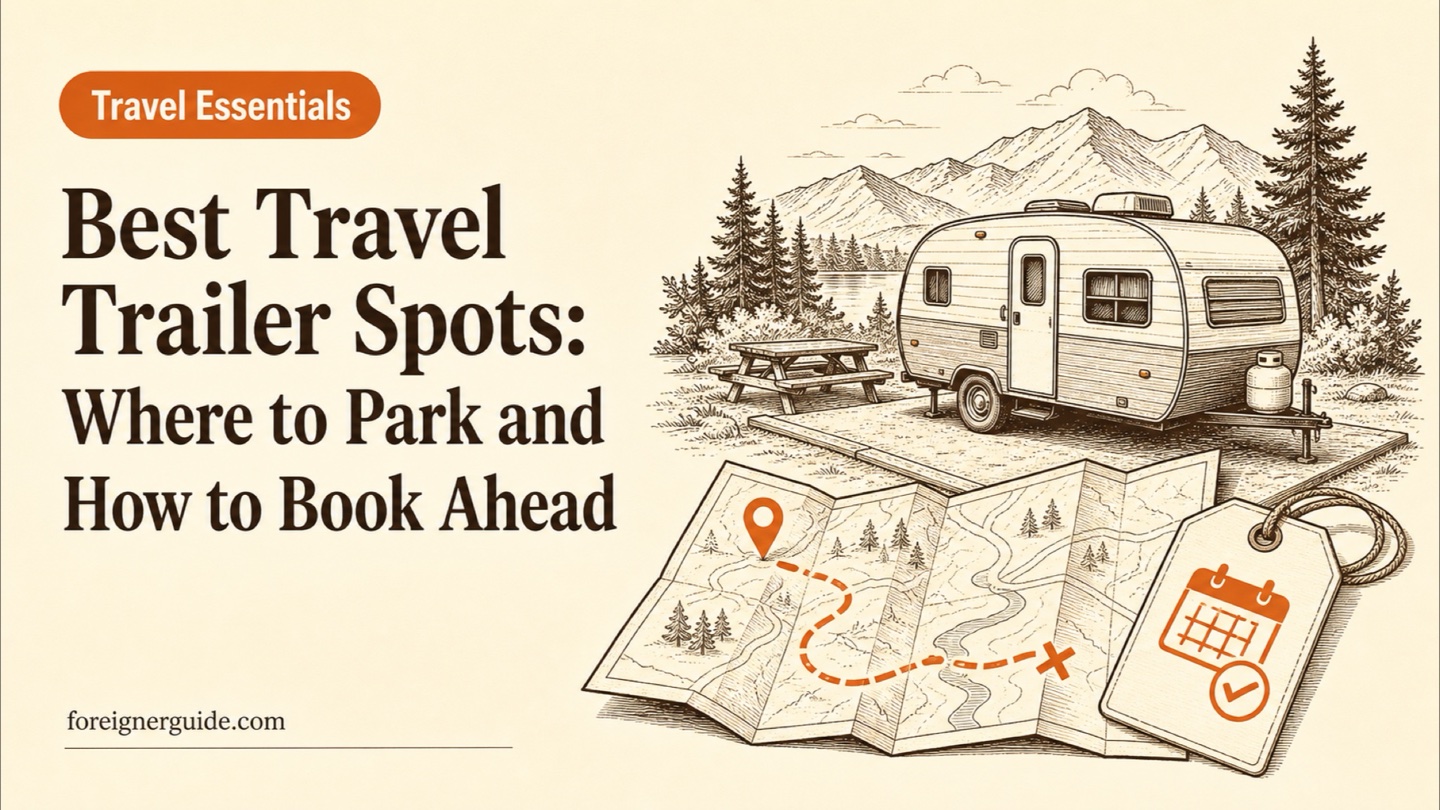
Best Travel Trailer Spots: Where to Park and How to Book Ahead
The best travel trailer spot depends on hookups and timing: book U.S. parks 6 months out, use free BLM land if self-contained, and compare spots by app.
Table of contents
The best travel trailer spot depends on what your rig needs and how early you can commit: a full-hookup site if you want power and water, a free public-land site if your trailer is self-contained, or a host farm for a one-night stop. As of July 2026, the U.S. federal system Recreation.gov releases most campsites six months ahead, while the Bureau of Land Management allows free dispersed camping for up to 14 days at a time. This guide is for international travelers renting or towing a travel trailer in the United States or Europe; it does not cover rental contracts, towing licenses, or insurance.
What makes a travel trailer spot right for you
A travel trailer is a towable camper you pull behind a car or truck, with no engine of its own. The right spot to park it comes down to three things: whether you need hookups (electric, water, and sewer connections at the site), how far in advance you can commit to dates, and whether your trailer is self-contained, meaning it carries its own water and waste tanks so you can stay somewhere with no facilities.
Spots fall into a few types. Full-hookup RV parks and private campgrounds give you power and water at the site, usually for a nightly fee. Public campgrounds in national and state parks sit closer to nature and cost less, but fill early. Dispersed sites on public land are free and remote, with no water or toilets. Host networks let you park overnight on a farm, winery, or brewery, often in exchange for a small purchase. Matching the spot type to how your trailer is equipped matters more than chasing one perfect location.
How far ahead should you book a campsite?
For popular U.S. parks, book about six months out. Recreation.gov, the federal reservation system for national parks and other public lands, releases most campsites six months in advance at 10:00 a.m. Eastern Time on a rolling daily basis, so a July 15 arrival opens for booking on January 15. High-demand parks such as Yosemite and Yellowstone can sell out within minutes of the window opening, so set a reminder for the exact release time.
Not every site works this way. Recreation.gov notes that some U.S. Forest Service and Bureau of Land Management campgrounds open only 14 days ahead. These are a useful fallback if you missed the six-month window, because they tend to fill more slowly. You can browse and book federal sites directly at recreation.gov.
Free and low-cost spots on public land
If your trailer is self-contained, free camping is realistic. The Bureau of Land Management (BLM), the U.S. agency that manages large areas of public land mostly in the western states, allows dispersed camping, which means camping outside developed campgrounds with no hookups or services. According to the BLM, dispersed camping is generally limited to 14 days within any 28-day period, after which you must move to a new area, often 25 miles or more away. Stays under 14 days usually need no permit or fee.
A few rules keep this legal and low-impact: keep vehicles on existing roads and trails, don't leave belongings unattended for more than 10 days, and check the local field office, since limits vary by state. The BLM publishes area-specific rules at blm.gov. Host networks are another low-cost route. As of July 2026, Harvest Hosts lists three annual plans on its site: Classic at $99, Classic plus Boondockers Welcome at $169, and All Access at $179, with overnight stays at 9,500 or more farms, wineries, and similar hosts across 49 U.S. states and 10 Canadian provinces. Details are at harvesthosts.com.
Apps that help you find and compare spots
Finding a good spot is mostly about the right app, and the useful ones carry reviews, photos, and cell signal reports, which matter for anyone who needs to stay connected. The table below compares four widely used tools and their pricing as reported by each service as of July 2026. If you work remotely while traveling, cell-coverage data is often the deciding factor between two otherwise similar sites.
| App | Cost (as of July 2026) | Best coverage | Standout feature |
|---|---|---|---|
| iOverlander | Free | Worldwide | Web map, no account needed |
| Campendium | Pro $20/year | United States | Cell signal strength reports |
| The Dyrt | Pro $36/year | United States | Offline maps, free-camping layer |
| park4night | Premium about €9.99/year | Europe, 100+ countries | Aires and Stellplatz listings |
iOverlander's web version gives full worldwide map access without an account, which makes it a solid free starting point. The paid tiers on Campendium and The Dyrt mainly add offline maps and coverage data, worth the cost if you camp more than a handful of nights a year.
Where do travel trailers park in Europe?
In Europe, look for designated motorhome areas rather than large RV parks. France calls them aires, Germany calls them Stellplätze, and Italy calls them sostas: small, signposted areas built for overnight camper stays, priced anywhere from free to around €15 a night. The park4night app maps them alongside campsites and informal stopovers, and the company reports over 370,000 spots across more than 100 countries, with a premium tier around €9.99 a year that adds offline access for places with no signal.
One caution for non-EU travelers: rules on where you can stop overnight vary by country and sometimes by town, and border crossings can shape a longer trip. If your route passes through several countries, it pays to spend a few minutes confirming entry and visa rules before you commit to dates.
A quick pre-booking checklist
Before you reserve or roll up to a free site, confirm a short list: your trailer's total length, since many sites cap rig length; whether you need hookups or can go self-contained; the site's cancellation policy; and the exact reservation release time for popular parks. For international trips, add local overnight-parking rules and, if you are crossing borders, entry requirements. Getting these four or five details right turns a good-looking spot into one that actually works for your trailer.